Evidence
What the evidence shows
Unhealthy normal skin doesn't announce itself with drama - it whispers through subtle changes in how skin looks, feels, and behaves. Catching these whispers early is the key to restoring balance.
Does your skin feel tight after cleansing?
Yes → Likely dehydratedIs your skin reacting to products it used to tolerate?
Yes → Barrier may be compromisedDoes your skin look dull or lack its usual glow?
Yes → Surface health may be declining
Use this section to decide
Does this advice apply to me?
Find the concern or goal closest to yours, then use the fit signal to decide how much weight to give this guide.If your goal is
Visual signsDepends- Fit signal
- Possible fit
Dullness, texture, uneven tone
If your goal is
Sensory signsDepends- Fit signal
- Possible fit
Tightness, sensitivity, discomfort
If your goal is
Primary causeUse caution- Fit signal
- Limited evidence
Barrier compromise, dehydration
If your goal is
Recovery outlookUsually relevant- Fit signal
- Often useful
Good with proper care
Research notes already in this guide
- Dull, lackluster complexion with reduced glow
- Visible texture changes, including rough or grainy feel
- Uneven tone, often with redness or mild inflammation
- Fine lines that appear more noticeable than usual
Expected results
Results and timeframe
Recovery takes patience - usually 1 to 4 weeks of consistent care.
Practical use
How to use it
Simplify your routine
Strip back to a gentle cleanser, moisturizer, and SPF.
Boost hydration
Add a hydrating serum with glycerin or hyaluronic acid.
Protect and be patient
Give the skin 1-4 weeks to recover with consistent, gentle care.
Safety
Side effects and cautions
- Ignoring early signs as "not a big deal"
Subtle changes are easier to reverse than full-blown problems.
- Using more products to fix the problem
Unhealthy skin often needs less, not more - simplicity supports healing.
- Continuing the same routine hoping things will improve
If the routine contributed to the problem, it won't fix it.
- Dull complexion
Common · Focus on hydration and gentle exfoliation
- Tightness after washing
Common · Switch to a gentler cleanser and richer moisturizer
- Increased sensitivity
Occasional · Simplify routine and use barrier-supporting products
Fit
Who should be careful
- Ignoring persistent changes
Worth noting
Small details that can change the answer
- Hydration Check. Skin that feels tight after cleansing is giving a clear signal it's losing moisture faster than it should.
- Tone Changes. Unhealthy normal skin often looks dull because the surface reflects light less evenly.
- Sensitivity Risk. A lowered tolerance to products is often the first sign that the barrier is compromised.
- Elasticity Decline. Loss of bounce and firmness can indicate dehydration or collagen breakdown from cumulative damage.
Unhealthy normal skin shows subtle signs: dullness, tightness, sensitivity, texture changes, and uneven tone.
These signs usually reflect temporary imbalance rather than permanent damage.
A compromised barrier is the common underlying cause.
Simpler, more hydrating care is the most effective response.
Definition
What "unhealthy" means for normal skin
Unhealthy normal skin doesn't mean it's suddenly become oily or dry; it means the skin's usual balance has been disrupted. The barrier may be compromised, hydration levels may be low, or the skin may be responding to cumulative environmental stress. It's a state of temporary imbalance, not a new permanent skin type.
Explanation
The sensory signs
Unhealthy normal skin often feels different before it looks different. Tightness after cleansing is a classic early warning sign. Products that used to be soothing may now cause stinging or tingling. The skin may feel more sensitive to touch and less comfortable overall.
Science
What's happening under the surface
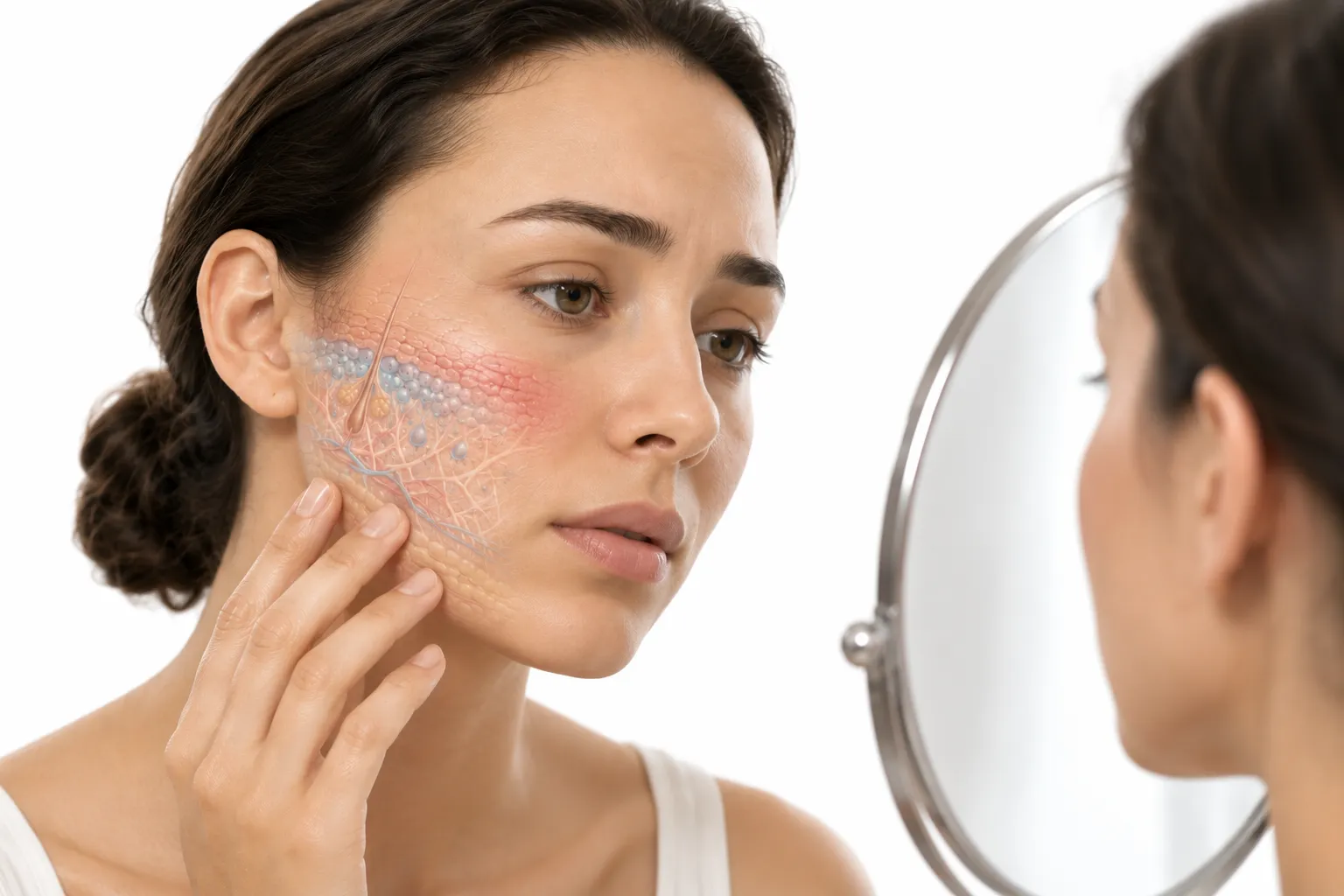
When normal skin becomes unhealthy, the underlying causes often involve barrier dysfunction, reduced natural moisturizing factors, and increased inflammatory activity. The stratum corneum (the outermost layer) loses its ability to hold water effectively, leading to dehydration and vulnerability to irritants.
- Barrier dysfunction
- A weakened outer skin layer that fails to retain water and protect against irritants.
- Natural moisturizing factors
- The skin's own moisturizing compounds that help it hold onto water.
Risks
What happens if signs are ignored
Dismissing the early signs of unhealthy normal skin allows the underlying problems to accumulate. Over time, this can lead to more persistent issues that take longer to resolve.
- Chronic dehydration that dulls the complexion
- Accelerated appearance of fine lines and wrinkles
- Increased sensitivity that limits product options
- Difficulty maintaining balanced skin overall
Questions
Frequently asked questions
Can unhealthy normal skin become permanently damaged?
Rarely. Most cases resolve with proper care and barrier support.
Is unhealthy normal skin the same as sensitive skin?
Not necessarily. Temporary sensitivity is a sign of distress; chronic sensitivity may be a type.
How long does it take for unhealthy skin to recover?
With consistent care, many people see improvement in 1-4 weeks.
Can diet and lifestyle affect normal skin health?
Yes - sleep, stress, hydration, and nutrition all influence skin condition.
References
Sources
The notes below are drawn from the evidence already cited in this guide. They are not a complete bibliography.
- Dull, lackluster complexion with reduced glow
- Visible texture changes, including rough or grainy feel
- Uneven tone, often with redness or mild inflammation
- Fine lines that appear more noticeable than usual