Evidence
What the evidence shows
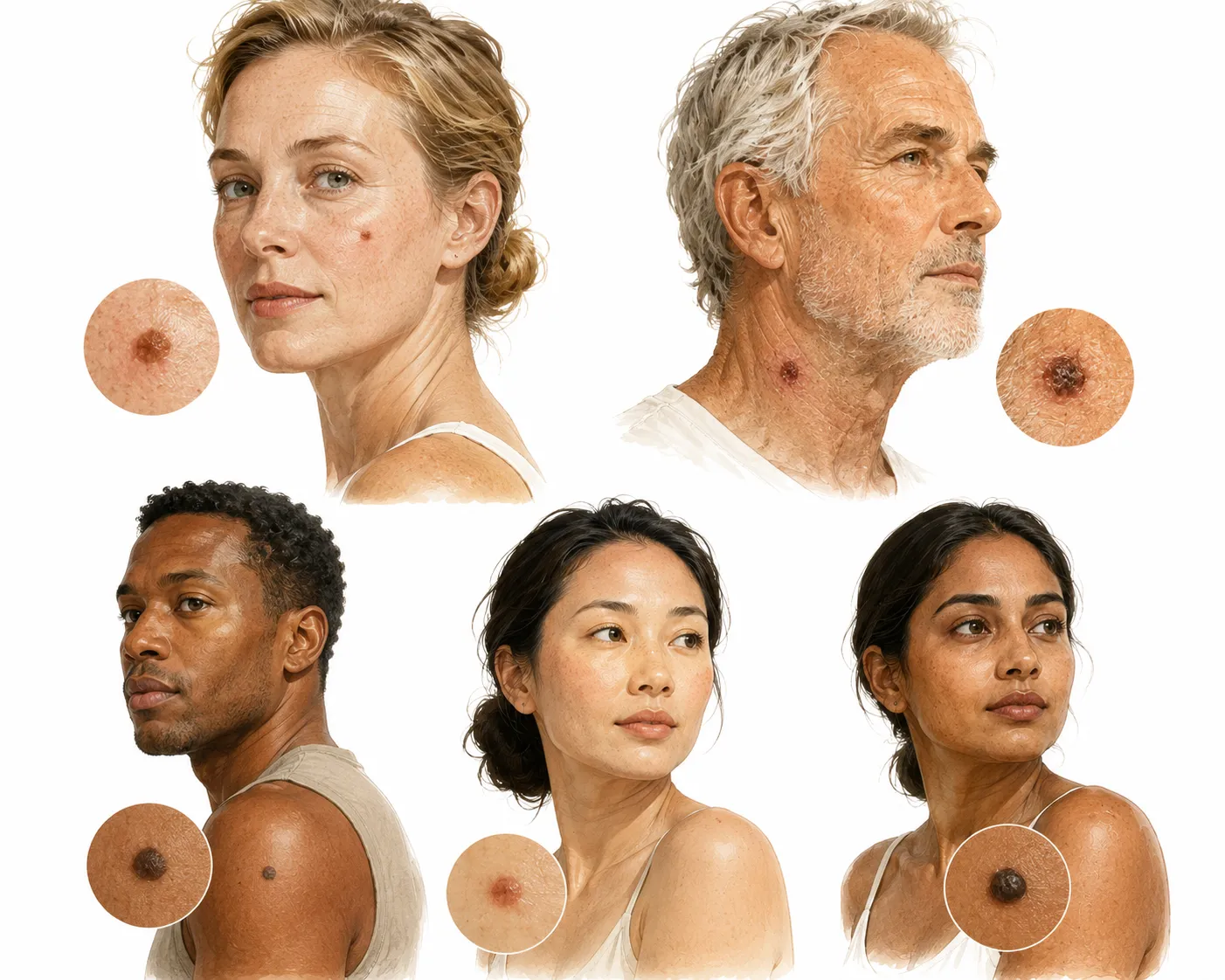
No description here is a substitute for a professional skin check. These are general patterns meant to help you recognize when something is worth having examined, not a way to rule skin cancer in or out on your own.
Use this section to decide
Does this advice apply to me?
Find the concern or goal closest to yours, then use the fit signal to decide how much weight to give this guide.If your goal is
Most commonUse caution- Fit signal
- Limited evidence
Basal cell carcinoma
If your goal is
Most seriousDepends- Fit signal
- Possible fit
Melanoma
If your goal is
Key screening toolUse caution- Fit signal
- Limited evidence
ABCDE rule
If your goal is
EvidenceUsually relevant- Fit signal
- Often useful
Strong
Practical use
How to use it
Check your skin regularly
Look for new spots or changes to existing moles, ideally with a full-body check every few months.
Apply the ABCDE rule to moles
Watch for asymmetry, irregular borders, uneven color, larger diameter, or evolving appearance.
See a dermatologist for anything concerning
A professional skin exam is the only reliable way to evaluate a suspicious spot.
Safety
Side effects and cautions
- Trying to self-diagnose from photos or descriptions alone
Use general knowledge to know when something warrants a check, not to rule skin cancer in or out yourself.
- Waiting to see if a suspicious spot changes before seeking care
Early evaluation generally leads to better outcomes, especially for melanoma.
- Assuming only sun-exposed areas need checking
While common on sun-exposed skin, skin cancer can occur on any part of the body, including areas rarely exposed to sun.
- New or changing mole
See a dermatologist for evaluation.
- Non-healing sore
Have it examined, especially if present for several weeks.
- Mole matching ABCDE signs
Seek prompt professional evaluation.
Fit
Who should be careful
- Self-diagnosing or ruling out skin cancer
Helpful context
What else is worth knowing
What the evidence suggests
Early detection is strongly associated with better outcomes across skin cancer types, particularly melanoma.
Regular self-checks and professional skin exams support earlier detection.
Worth noting
Small details that can change the answer
- BCC. Basal cell carcinoma is the most common type of skin cancer and typically grows slowly.
- SCC. Squamous cell carcinoma often appears on sun-exposed skin and can sometimes grow more quickly than basal cell carcinoma.
- Melanoma. Melanoma is less common but more likely to spread if not caught early, making early detection especially important.
- ABCDE Rule. The ABCDE rule (asymmetry, border, color, diameter, evolving) is a widely used screening guide for evaluating moles.
Basal cell carcinoma often looks like a pearly or waxy bump.
Squamous cell carcinoma often appears as a firm, red, scaly patch or non-healing sore.
Melanoma often develops from a changing mole, assessed using the ABCDE rule.
Skin cancer can occur on any part of the body, not only sun-exposed areas.
Any new or changing spot is worth having evaluated by a dermatologist.
Basal cell carcinoma - common signs
- A pearly or waxy-looking bump
- Visible small blood vessels on or near the bump
- A sore that bleeds, heals, and returns
- A flat, scar-like lesion in some cases
Squamous cell carcinoma - common signs
- A firm, red, scaly patch
- A sore that doesn't heal or keeps returning
- A wart-like or crusted growth
- Often located on sun-exposed areas like the face, ears, or hands
Melanoma - common signs (the ABCDE rule)
- Asymmetry - one half doesn't match the other
- Border - irregular, ragged, or blurred edges
- Color - uneven color or multiple shades within one spot
- Diameter - larger than about 6mm, roughly a pencil eraser
- Evolving - any change in size, shape, or color over time
When to see a dermatologist
- Any new or changing mole or spot
- A sore that does not heal within a few weeks
- A spot that itches, bleeds, or becomes tender
- Any lesion matching the ABCDE warning signs
Questions
Frequently asked questions
What does basal cell carcinoma look like?
It often appears as a pearly or waxy bump, sometimes with visible small blood vessels, and typically grows slowly.
How can I tell if a mole might be melanoma?
The ABCDE rule, checking asymmetry, border irregularity, color variation, diameter, and evolving change, is a commonly used screening guide, though only a dermatologist can properly evaluate a mole.
Is skin cancer only found on sun-exposed skin?
Most commonly, yes, but it can occur on any part of the body, including areas rarely exposed to sun.
How often should I check my skin for cancer?
Many dermatologists recommend a self-check roughly every few months, along with periodic professional skin exams.