Evidence
What the evidence shows
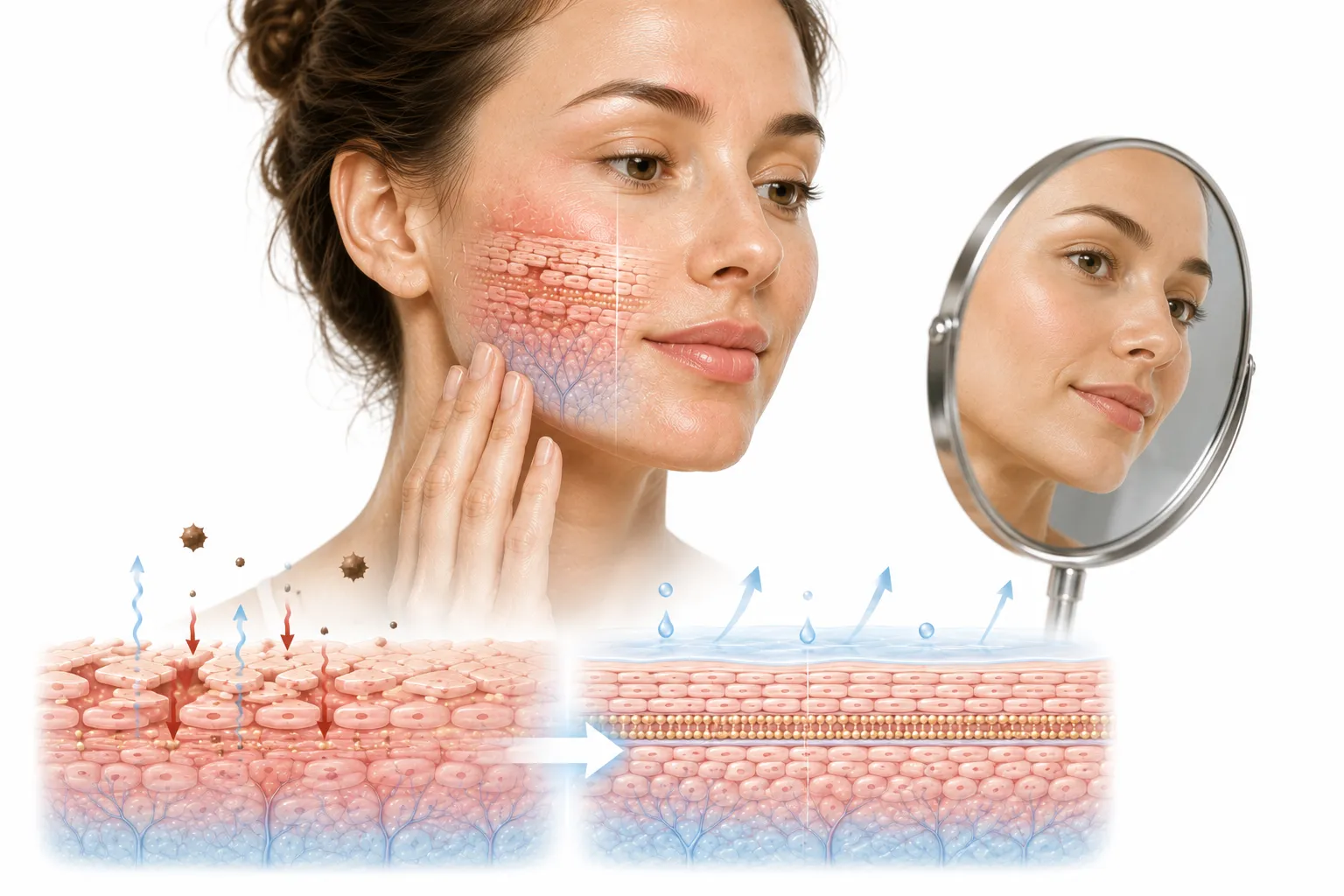
The skin barrier's repair mechanisms are robust - it's not a question of if it can heal, but of whether you'll give it the conditions it needs to do so.
Use this section to decide
Does this advice apply to me?
Find the concern or goal closest to yours, then use the fit signal to decide how much weight to give this guide.If your goal is
Is it permanent?Usually relevant- Fit signal
- Often useful
No
If your goal is
Mild damageUse caution- Fit signal
- Limited evidence
1-2 weeks
If your goal is
Moderate damageUse caution- Fit signal
- Limited evidence
4-6 weeks
If your goal is
Severe damageDepends- Fit signal
- Possible fit
3-6 months
Explanation
How it works
Stop the damage
Remove all exfoliants, retinoids, acids, and potential irritants.
Support the repair process
Use barrier-specific ingredients (ceramides, niacinamide, panthenol).
Allow time for turnover
New cells need time to replace damaged ones - typically 4-6 weeks.
Maintain healthy barrier
After recovery, protect your barrier with gentle, consistent care.
Expected results
Results and timeframe
Recovery takes time - 1-2 weeks for mild damage, weeks to months for severe damage.
Be patient and consistent; your barrier will recover.
Practical use
How to use it
Stop all damaging products immediately
No acids, retinoids, vitamin C, or other active ingredients.
Simplify your routine to basics
Cleanse with a gentle, pH-balanced cleanser and apply a barrier-supporting moisturizer.
Be patient and consistent
Expect improvement in weeks, not days. Full repair may take months.
Safety
Side effects and cautions
- Continuing to use active ingredients while "trying" to repair
You must stop all exfoliants and actives for the barrier to recover.
- Expecting overnight results
Barrier repair takes time - be patient and consistent.
- Skipping moisturizer because your skin feels oily
Barrier repair requires hydration; use a suitable moisturizer.
Fit
Who should be careful
- Severe, chronic conditions that need medical intervention
Worth noting
Small details that can change the answer
- Self-Repair Capacity. The skin barrier has evolved to repair itself efficiently after damage.
- Turnover Time. Complete epidermal turnover takes approximately 28 days in healthy skin.
- Recovery Timeline. Recovery time depends on the severity of damage and how quickly you stop the cause.
- Long-Term Damage. Even severe barrier damage can recover within months with consistent care.
A damaged skin barrier is not permanent.
The skin's self-repair mechanisms are powerful but need the right conditions.
Stop all damaging products and support repair with barrier-specific ingredients.
Definition
What is a damaged skin barrier?
A damaged skin barrier is one where the stratum corneum has lost its structural integrity. This can happen through physical damage (over-exfoliation, harsh scrubbing), chemical damage (drying alcohols, acids), or environmental damage (low humidity, UV exposure). Signs include tightness, stinging, flaking, redness, and increased sensitivity to products.
- Tight, uncomfortable skin that feels stretched
- Stinging or burning when applying products
- Redness, inflammation, or visible irritation
- Increased flaking, peeling, or rough texture
- Increased sensitivity to products that were previously well-tolerated
- More frequent breakouts or skin infections
Science
The biology of barrier repair
When the barrier is disrupted, keratinocytes in the epidermis detect the change through calcium gradients and other signaling mechanisms. This triggers a wound-healing response that includes increased production of new cells (to replace damaged ones) and increased synthesis of barrier lipids (to restore the lipid matrix). This is a natural, programmed response that your skin has been designed to execute.
- Keratinocyte
- The primary cell type in the epidermis, responsible for producing keratin and forming the barrier.
- Lipid Synthesis
- The production of ceramides, cholesterol, and fatty acids that form the barrier's "mortar."
Risks
Factors that can delay or prevent barrier recovery
Some factors can significantly impair your skin's ability to repair itself.
- Continued use of irritating or damaging products
- Underlying skin conditions (eczema, psoriasis, rosacea)
- Immune suppression or chronic illness
- Severe nutritional deficiencies (especially essential fatty acids)
- Extreme environmental stress (severe cold, low humidity)
- Chronic stress, which impairs healing through cortisol pathways
Benefits
What you can do to support barrier recovery
Your skin's self-repair mechanisms are powerful, but they need the right conditions to work effectively.
- Stop using all exfoliants, retinoids, and active ingredients
- Use a gentle, pH-balanced cleanser (once or twice daily)
- Apply a barrier-supporting moisturizer with ceramides and niacinamide
- Protect from UV exposure with sunscreen
- Maintain adequate hydration and a nutrient-rich diet
- Be patient - consistent care over weeks to months is essential
Questions
Frequently asked questions
Can a damaged skin barrier recover fully?
Yes, in most cases the barrier can recover fully with the right care.
How long does a damaged skin barrier take to heal?
It depends on the severity. Mild damage: 1-2 weeks; moderate: 4-6 weeks; severe: 3-6 months.
What happens if I don't treat a damaged barrier?
It may heal on its own if you stop damaging it, but chronic damage can lead to persistent sensitivity and irritation.
Can a damaged barrier cause permanent sensitivity?
Not usually, but prolonged or chronic damage can increase sensitivity that takes longer to resolve.