Evidence
What the evidence shows
The most permanent form of sun damage is at the DNA level, where mutations accumulate over a lifetime. Even with treatment, the underlying genetic changes can't be fully erased.
Recent sunburn?
Likely reversible with time and careFine lines and uneven texture?
Partially reversible with treatmentDeep wrinkles and sagging?
Permanent without intervention
Use this section to decide
Does this advice apply to me?
Find the concern or goal closest to yours, then use the fit signal to decide how much weight to give this guide.If your goal is
DNA damageUsually relevant- Fit signal
- Often useful
Reversible
If your goal is
Collagen lossUse caution- Fit signal
- Limited evidence
Permanent
If your goal is
HyperpigmentationDepends- Fit signal
- Possible fit
Can improve
If your goal is
WrinklesUse caution- Fit signal
- Limited evidence
Permanent
Research notes already in this guide
- DNA damage can be repaired naturally within 24-48 hours of UV exposure.
- Collagen degradation is cumulative and largely irreversible without intervention.
- Hyperpigmentation often improves with treatment but may persist.
- Skin cancer risk increases with cumulative UV exposure and doesn't decrease.
Expected results
Results and timeframe
Treatment can improve the appearance of photodamage but may not fully reverse it.
Practical use
How to use it
Start with prevention
Daily sunscreen use prevents new damage from accumulating.
Support with active ingredients
Retinoids, vitamin C, and other actives can help improve visible sun damage.
See a professional for serious damage
Dermatologists can provide treatments like lasers, chemical peels, and prescription retinoids.
Safety
Side effects and cautions
- Assuming all skin damage is irreversible
Some types of sun damage can improve significantly with proper care.
- Using treatments as an excuse to skip sunscreen
Preventing further damage is essential for any treatment to work.
- Expecting overnight improvement
Improvement takes time and consistent effort.
Fit
Who should be careful
- Seeking a simple yes or no answer
Worth noting
Small details that can change the answer
- Photodamage Accumulation. Sun damage builds over a lifetime, with about 80% of visible aging attributed to UV exposure.
- Repair Timeframe. DNA repair is most active within 24 hours of UV exposure, after which damage becomes more permanent.
- Collagen Decline. After age 30, the skin loses about 1% of its collagen each year, and UV exposure accelerates this loss.
- Pigment Persistence. Sunspots and hyperpigmentation can fade but often become a permanent fixture without active treatment.
Not all sun damage is permanent; DNA damage can be repaired within 24-48 hours.
Collagen degradation and elastin damage are largely permanent without treatment.
Hyperpigmentation can fade but often requires active treatment.
Skin cancer risk accumulates and does not decrease.
Definition
What makes sun damage permanent or reversible
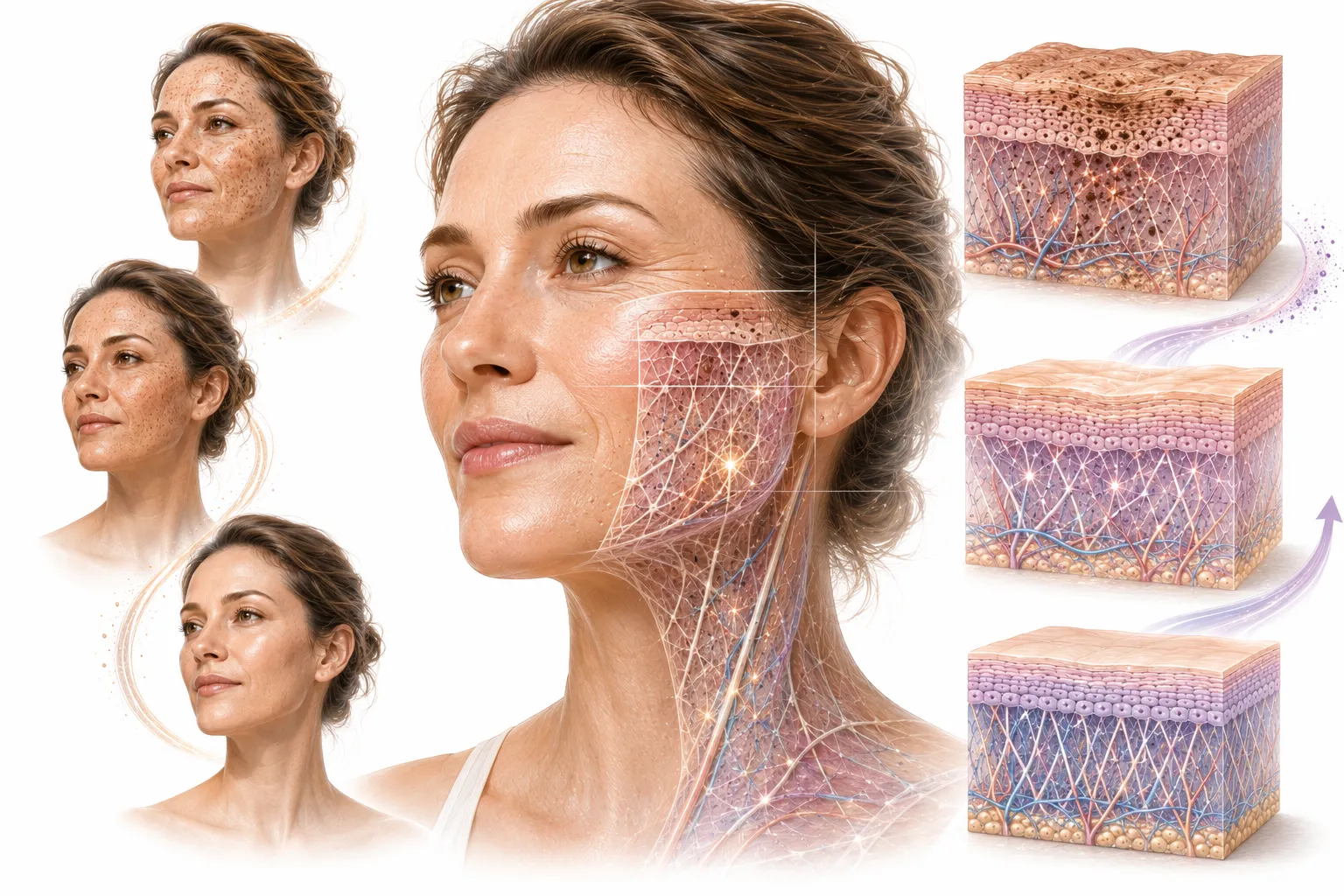
The permanence of sun damage depends on whether the damage occurs at the molecular level, cellular level, or structural level. Reversible damage tends to be at the molecular level where DNA and cellular proteins can be repaired or replaced. Permanent damage involves structural components like collagen and elastin that the body cannot effectively regenerate.
- Reversible: DNA damage (within 24-48 hours), superficial pigmentation
- Partially reversible: Some hyperpigmentation, texture changes
- Permanent: Collagen degradation, elastin damage, established wrinkles, DNA mutations that persist
Science
The biology of permanent skin damage
UV exposure activates enzymes called matrix metalloproteinases that break down collagen and elastin fibers. These enzymes are activated by UV exposure and remain active for hours after sun exposure. The degradation is cumulative and the body's ability to replace these structural proteins decreases with age, making the damage functionally permanent.
- Matrix Metalloproteinases
- Enzymes that break down collagen and elastin, activated by UV radiation and oxidative stress.
- Solar Elastosis
- The degradation and clumping of elastin fibers caused by chronic UV exposure, leading to leathery, yellowed skin.
Myth Reality
Common misconceptions about sun damage permanence
Some damage, particularly DNA damage from recent exposure, can be repaired naturally.
The effects of past sun exposure continue to manifest over time.
No topical treatment can fully reverse collagen degradation or DNA mutations.
Questions
Frequently asked questions
Can a sunburn cause permanent damage?
A severe sunburn can cause DNA damage that increases cancer risk, but the visible effects typically fade within a week.
Does sun damage get worse with age even without more sun?
Yes, accumulated damage continues to manifest as collagen production decreases with age.
Can retinol reverse sun damage?
Retinol can improve the appearance of photodamage by increasing cell turnover and collagen production, but it can't fully reverse structural damage.
What sun damage is considered permanent?
Wrinkles, sagging, leathery texture, and permanent pigmentation changes are generally considered permanent without treatment.
References
Sources
The notes below are drawn from the evidence already cited in this guide. They are not a complete bibliography.
- DNA damage can be repaired naturally within 24-48 hours of UV exposure.
- Collagen degradation is cumulative and largely irreversible without intervention.
- Hyperpigmentation often improves with treatment but may persist.
- Skin cancer risk increases with cumulative UV exposure and doesn't decrease.