Evidence
What the evidence shows
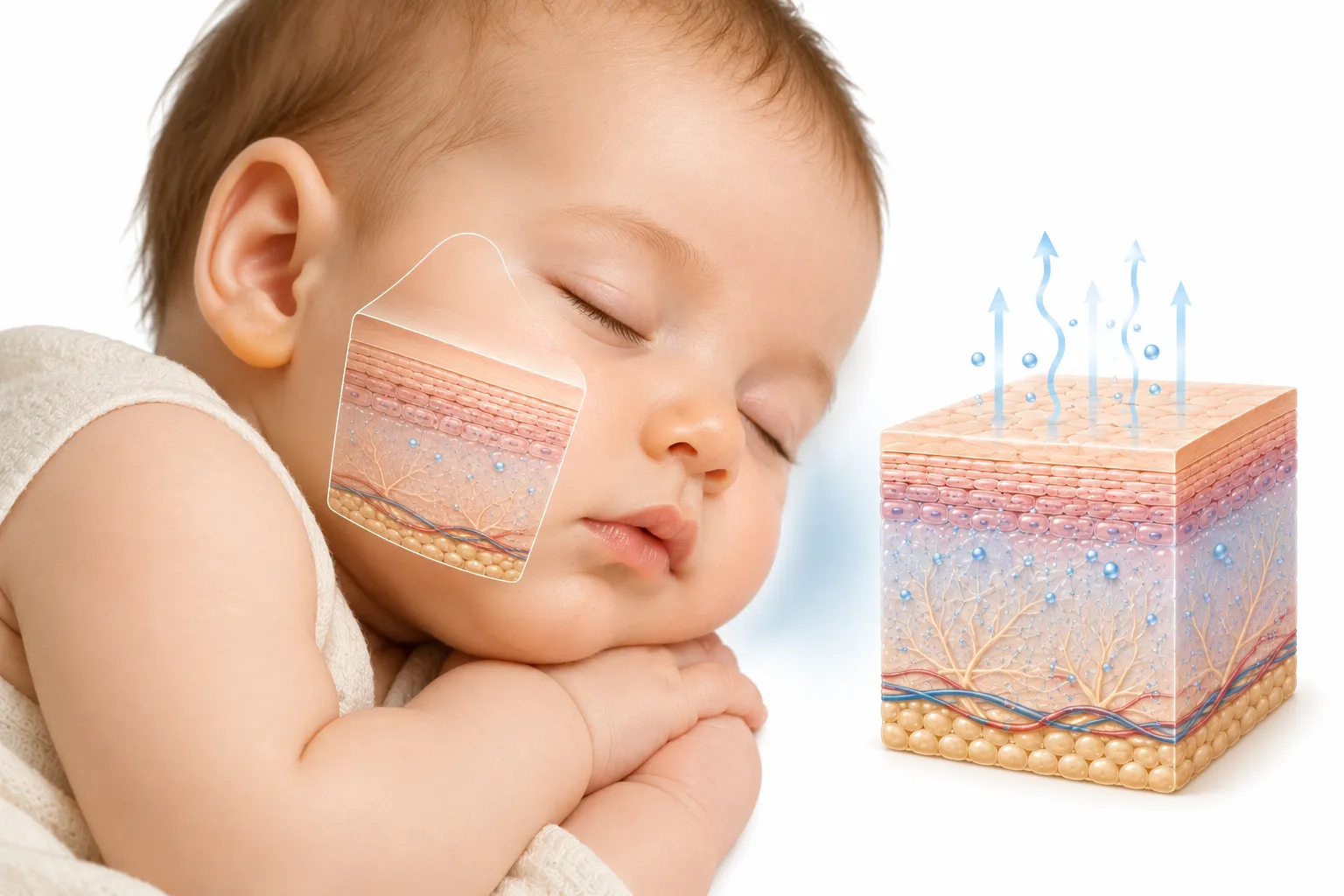
A baby's skin isn't just smaller adult skin - it's structurally different, with a barrier that takes months to reach full function.
Skin structure
Well documentedBarrier development
Well understoodCare recommendations
Evidence-based
Use this section to decide
Does this advice apply to me?
Find the concern or goal closest to yours, then use the fit signal to decide how much weight to give this guide.If your goal is
Skin thicknessUse caution- Fit signal
- Limited evidence
30% thinner than adult
If your goal is
Barrier statusUse caution- Fit signal
- Limited evidence
Developing
If your goal is
pH levelUse caution- Fit signal
- Limited evidence
Higher, less acidic
If your goal is
Care approachUsually relevant- Fit signal
- Often useful
Gentle and minimal
Explanation
How it works
Thinner protective layer
The outer skin layer is about 30% thinner than in adults.
Fewer barrier lipids
Lower levels of ceramides mean less effective moisture and irritant protection.
Higher permeability
Substances penetrate through the barrier more easily.
Changing pH
The skin's protective acid mantle develops over time.
Practical use
How to use it
Keep it simple
Use minimal, gentle products designed specifically for babies.
Bathe gently
Use lukewarm water and a gentle baby cleanser, avoiding scrubbing.
Pat dry and moisturize
Gently pat skin dry and apply a baby-appropriate moisturizer.
Safety
Side effects and cautions
- Assuming baby skin needs special adult products
Baby skin requires products specifically formulated for its unique needs.
- Ignoring pH differences
Adult skin care products often have a lower pH than baby skin can tolerate.
- Using too many products
Minimal, gentle products are best for sensitive baby skin.
Fit
Who should be careful
- Those who think sensitivity is a problem to be solved - it's a normal stage
Worth noting
Small details that can change the answer
- Skin Thickness. Baby skin is roughly 30% thinner than adult skin.
- Barrier Development. The skin barrier continues to develop throughout the first year of life.
- Lipid Content. Baby skin has a different lipid profile with fewer ceramides.
- pH Balance. Baby skin has a higher initial pH that gradually becomes more acidic.
Baby skin is structurally different from adult skin, being about 30% thinner.
The barrier function develops over the first year of life, making initial skin more permeable.
Baby skin has different lipid composition and higher initial pH.
The sensitivity is a normal part of development, not a permanent condition.
Gentle, simple care is the best approach for baby skin.
Science
The anatomy of baby skin
Baby skin's sensitivity comes down to several structural factors. The stratum corneum, the outermost protective layer, is thinner and has fewer layers. The lipid composition is different, with lower proportions of barrier-supporting lipids like ceramides. And the skin contains more water but loses it more easily due to a less effective barrier. All of these factors make the skin more permeable to external substances.
- Stratum corneum
- The outermost layer of the skin, responsible for barrier function.
- Ceramides
- Lipid molecules that help form the skin's barrier.
Risks
Risks of baby skin sensitivity
Baby skin's sensitivity creates specific vulnerabilities that parents should be aware of.
- Higher risk of contact dermatitis and allergic reactions
- Greater susceptibility to diaper rash and other skin irritations
- More vulnerability to dryness and eczema
- Reduced defense against microbial infections
Dos Donts
Managing baby skin sensitivity
Do
Designed to be gentle and minimally irritating
Avoids stripping the developing barrier
Identifies reactions before widespread use
Avoid
May contain irritants or harsh ingredients
Can strip natural oils from developing skin
Common triggers for sensitivity
Questions
Frequently asked questions
When does baby skin stop being so sensitive?
The skin barrier typically matures significantly in the first 6-12 months of life.
Can baby skin become less sensitive over time?
Yes, as the barrier matures and the skin develops, sensitivity typically decreases.
Is baby skin more sensitive to the sun?
Yes, babies have less melanin and a thinner barrier, making sun protection especially important.
Are all baby skin sensitivities normal?
Some sensitivity is normal, but persistent or severe reactions should be evaluated.