Evidence
What the evidence shows
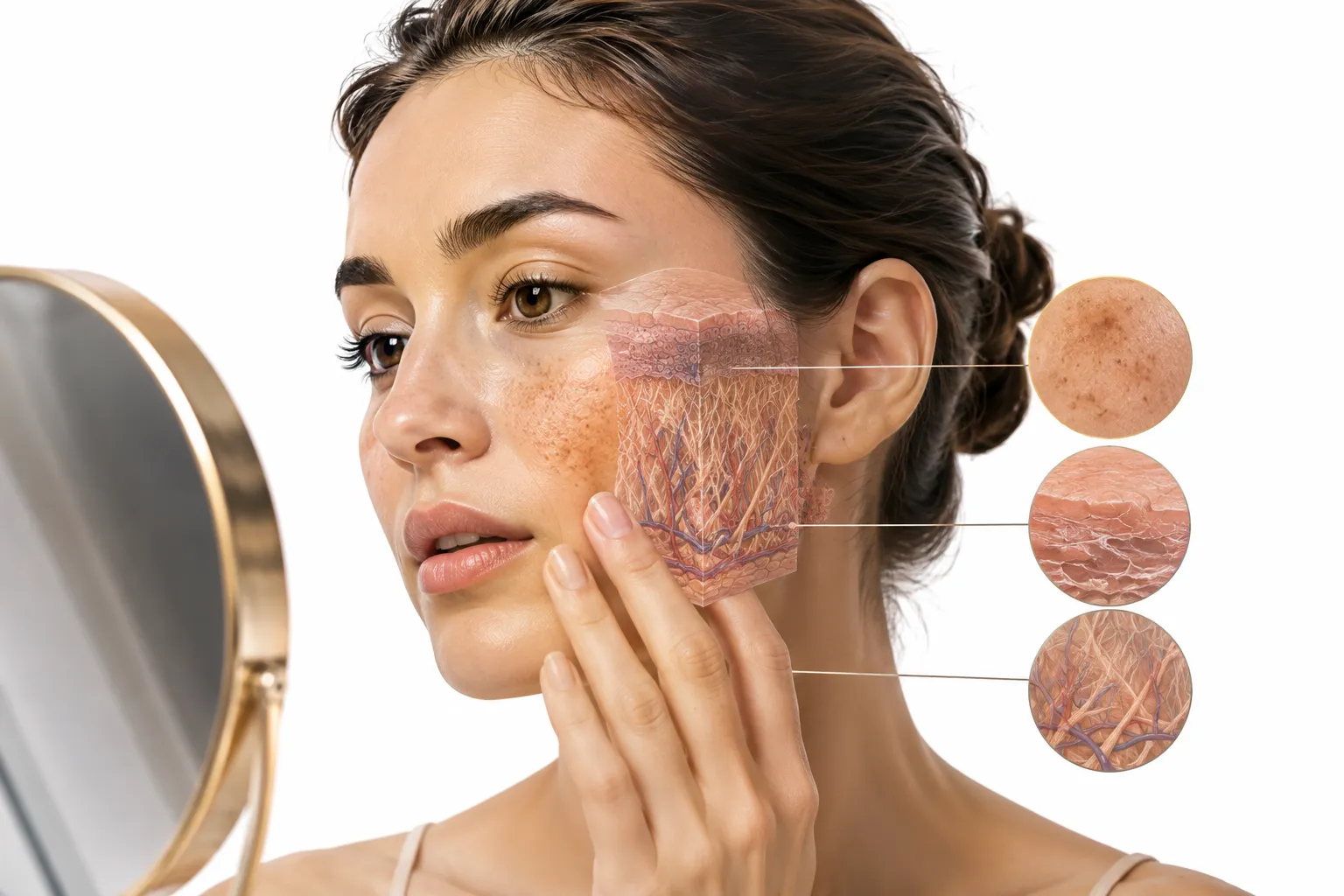
The early signs of sun damage are not dramatic but are detectable. They are a signal that the skin's structural proteins are beginning to break down faster than they are being repaired.
Do you notice fine lines around your eyes?
These are often the first sign of photoaging.Is your skin tone becoming uneven?
Subtle pigmentation changes are a common early sign.Does your skin feel less firm?
Loss of elasticity is an early indicator.
Use this section to decide
Does this advice apply to me?
Find the concern or goal closest to yours, then use the fit signal to decide how much weight to give this guide.If your goal is
Fine LinesUsually relevant- Fit signal
- Often useful
Around eyes and mouth
If your goal is
PigmentationDepends- Fit signal
- Possible fit
Subtle, uneven tone
If your goal is
TextureDepends- Fit signal
- Possible fit
Slightly rough
If your goal is
ElasticityDepends- Fit signal
- Possible fit
Loss of firmness
Research notes already in this guide
- Dermatologists use tools like UV photography to identify early signs of sun damage.
- The early signs are well-documented in clinical studies.
- Research shows that early intervention can improve outcomes.
Practical use
How to use it
Examine your skin regularly
Look for subtle changes in skin texture, tone, and lines.
Start using sunscreen daily
Choose SPF 30 or higher to protect against further damage.
Consider early intervention treatments
Use topical retinoids or vitamin C to help mitigate early signs.
Safety
Side effects and cautions
- Ignoring early signs as "normal aging"
While some changes are part of natural aging, many are related to sun exposure and can be slowed or reversed.
- Assuming it's too early for sun damage
Sun damage begins in childhood and accumulates over time.
- Neglecting to use sunscreen on cloudy days
UV radiation penetrates clouds, so sunscreen is essential every day.
Fit
Who should be careful
- Those with advanced photoaging who may need more intensive treatments
Worth noting
Small details that can change the answer
- Photoaging Onset. The earliest signs of photoaging can appear in the late 20s or early 30s, depending on sun exposure.
- Genetic Influence. Genetics influence how susceptible an individual is to photoaging.
- Cumulative Effect. The early signs are the result of cumulative damage, not a single exposure.
- Reversibility. Early signs of sun damage are more responsive to treatment than advanced signs.
Early signs of sun damage include fine lines, uneven pigmentation, and a loss of elasticity.
These signs are subtle and often mistaken for natural aging.
Catching them early allows for more effective intervention.
Daily sunscreen is essential to prevent further damage.
Over-the-counter treatments like retinoids can help reverse early signs.
Definition
Distinguishing early sun damage from natural aging
While sun damage is often confused with natural aging, there are distinctions. Early sun damage is more likely to appear on sun-exposed areas like the face and hands, while natural aging affects the whole body. Sun damage can also be asymmetric, affecting one side of the face more than the other. Recognizing these differences can help you understand the cause of the changes you're seeing.
- Fine lines and wrinkles in sun-exposed areas
- Uneven pigmentation and freckling
- Loss of elasticity and firmness
- A dry, rough texture
- Broken capillaries and redness
Science
What happens at the cellular level in early sun damage
In the early stages of sun damage, UV radiation triggers oxidative stress and an inflammatory response. The cells in the epidermis are damaged, leading to a thickening of the skin in some areas and thinning in others. In the dermis, fibroblasts are activated to produce more MMPs, which begin to break down collagen and elastin. The damage is still minor, and the skin's repair mechanisms are still working, but the damage is beginning to accumulate.
- Apoptosis
- Programmed cell death, triggered by UV damage.
- Fibroblast
- Cells in the dermis that produce collagen and other structural proteins.
Benefits
Why catching sun damage early matters
Intervening early can slow the progression of sun damage and improve the skin's appearance. Early signs are more responsive to over-the-counter treatments like retinoids and antioxidants, and they are easier to manage than more advanced signs.
- Early intervention can slow the progression of photoaging.
- It allows you to adopt protective measures to prevent further damage.
- It can save you from more extensive and costly treatments later.
- It can help you maintain healthier, more resilient skin over the long term.
Questions
Frequently asked questions
How early can sun-damaged skin start to show?
It can start in the late 20s, but it depends on sun exposure and genetics.
Is it possible to reverse early sun damage?
It is often possible to improve the appearance of early sun damage with treatments and lifestyle changes.
Can I use retinol for early sun damage?
Yes. Retinoids are one of the most effective treatments for photoaging.
How do I know if I have sun damage?
Look for the subtle signs described in this guide, and consult a dermatologist for a professional evaluation.
References
Sources
The notes below are drawn from the evidence already cited in this guide. They are not a complete bibliography.
- Dermatologists use tools like UV photography to identify early signs of sun damage.
- The early signs are well-documented in clinical studies.
- Research shows that early intervention can improve outcomes.