Evidence
What the evidence shows
The cause of sun-damaged skin isn't just the sun itself but the cumulative effect of oxidative stress and the inflammatory cascade that follows each exposure.
UV causes photoaging
UV causes photoagingOxidative stress is a key mechanism
Oxidative stress is a key mechanismPrevention is effective
Prevention is effective
Use this section to decide
Does this advice apply to me?
Find the concern or goal closest to yours, then use the fit signal to decide how much weight to give this guide.If your goal is
UVAUsually relevant- Fit signal
- Often useful
Deep penetration, aging
If your goal is
UVBUsually relevant- Fit signal
- Often useful
Surface damage, burning
If your goal is
MechanismDepends- Fit signal
- Possible fit
Oxidative stress
If your goal is
ResultDepends- Fit signal
- Possible fit
Collagen breakdown
Research notes already in this guide
- Decades of research have established UV radiation as the primary environmental cause of skin aging.
- Studies on twins have demonstrated the significant contribution of sun exposure to the visible signs of aging.
- Intervention studies have shown that reducing UV exposure slows the progression of photoaging.
Explanation
How it works
UV absorption
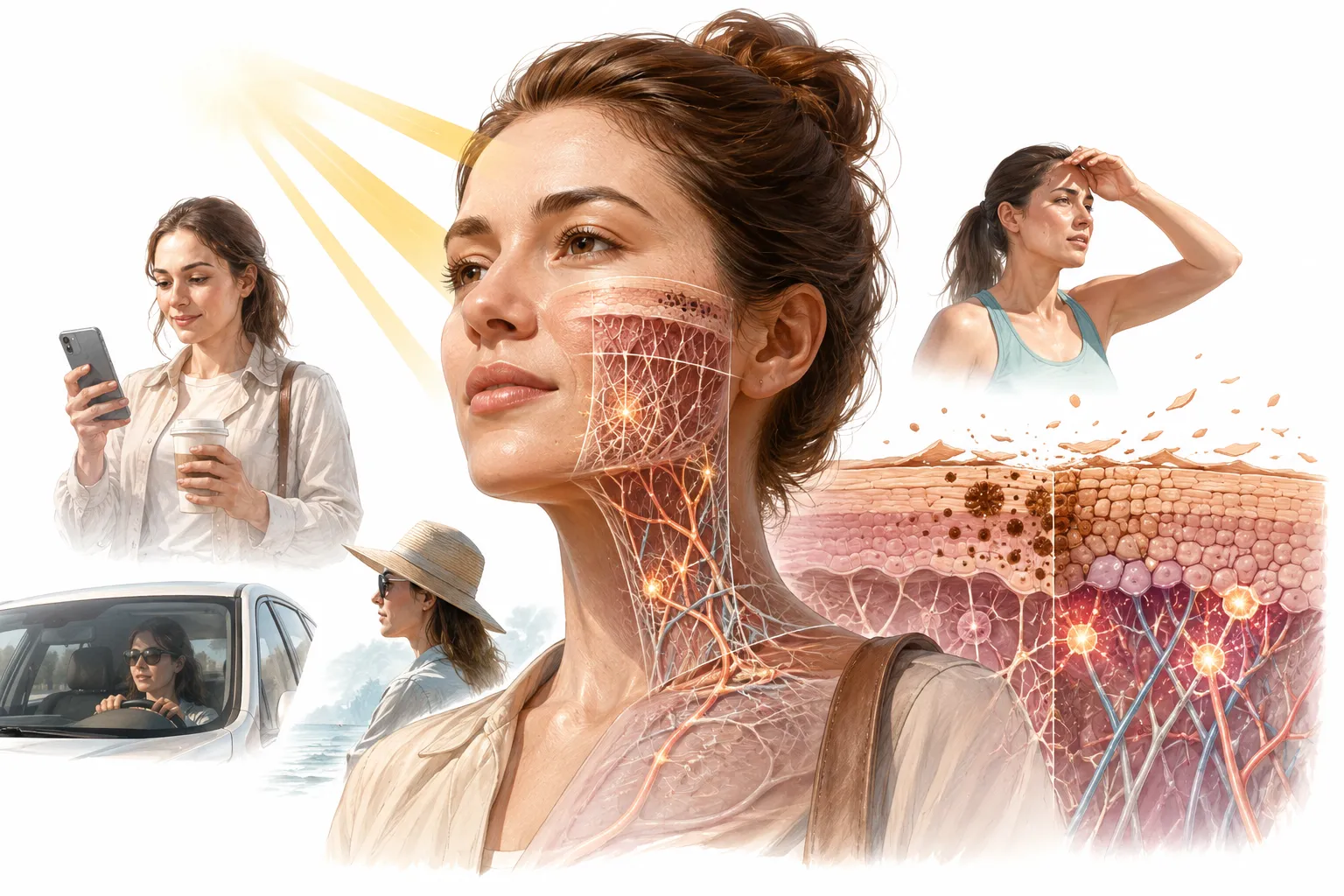
UV radiation is absorbed by chromophores in the skin, such as DNA and melanin.
Oxidative stress
Reactive oxygen species are generated, causing cellular damage.
Inflammatory response
The damaged cells trigger an inflammatory cascade.
Protein degradation
MMPs are activated, breaking down collagen and elastin.
Expected results
Results and timeframe
The damage is cumulative and occurs even without visible sunburn.
Practical use
How to use it
Apply broad-spectrum sunscreen daily
Choose SPF 30 or higher and apply to all exposed skin, even on cloudy days.
Wear protective clothing
Hats, long sleeves, and sunglasses reduce direct UV exposure.
Avoid peak sun hours
Limit outdoor time between 10 AM and 4 PM when UV radiation is strongest.
Safety
Side effects and cautions
- Believing that only sunburn causes damage
Sub-lethal UV exposure that does not cause sunburn still causes cumulative damage to collagen and DNA.
- Assuming sunscreen provides complete protection
Sunscreen reduces risk but does not eliminate it; protective clothing and shade are also important.
- Thinking that a tan is protective
A tan indicates UV damage has already occurred; it is not a healthy response.
Fit
Who should be careful
- Those looking for information on other causes of skin damage, such as pollution or smoking
Worth noting
Small details that can change the answer
- UVA Penetration. UVA radiation accounts for about 95 percent of the UV radiation that reaches the Earth's surface.
- UVB Intensity. UVB radiation is more intense during the middle of the day and in the summer months.
- Free Radicals. A single UV exposure can generate millions of free radicals in the skin.
- Cumulative Damage. Sun damage is cumulative and does not require visible sunburn to occur.
Sun-damaged skin is caused primarily by UVA and UVB radiation.
UVA penetrates deeply and is the main cause of photoaging.
UVB affects the epidermis and is the main cause of sunburn and DNA damage.
The damage is driven by oxidative stress and the activation of collagen-degrading enzymes.
Explanation
The two types of UV radiation and their effects
Understanding sun damage requires distinguishing between UVA and UVB. Both cause damage, but they do so in different ways and at different depths. UVA is the primary driver of photoaging, while UVB is the primary driver of sunburn and DNA damage that can lead to cancer.
Science
The cellular cascade: How UV radiation breaks down skin
UV radiation is absorbed by cellular chromophores, which then transfer energy to oxygen molecules, creating reactive oxygen species (ROS). These ROS then trigger a signaling cascade that results in the activation of NF-kB and AP-1, two transcription factors that regulate inflammation and collagen breakdown. The end result is the activation of MMPs that degrade collagen and elastin.
- Reactive Oxygen Species (ROS)
- Highly reactive molecules generated by UV exposure that cause oxidative damage to cells.
- Matrix Metalloproteinases (MMPs)
- Enzymes that degrade collagen and other components of the extracellular matrix.
Questions
Frequently asked questions
Is UVA or UVB more harmful?
Both are harmful, but they cause different types of damage. UVA causes photoaging, while UVB causes sunburn and DNA damage.
Can indoor light cause sun damage?
While some artificial lights emit small amounts of UV, the primary source of UV damage is natural sunlight.
Does sunscreen prevent all causes of sun damage?
Sunscreen reduces the risk but does not eliminate it entirely. It should be used with other protective measures.
Does tanning cause sun damage?
Yes. A tan is the skin's response to DNA damage, so it is a sign that damage has occurred.
References
Sources
The notes below are drawn from the evidence already cited in this guide. They are not a complete bibliography.
- Decades of research have established UV radiation as the primary environmental cause of skin aging.
- Studies on twins have demonstrated the significant contribution of sun exposure to the visible signs of aging.
- Intervention studies have shown that reducing UV exposure slows the progression of photoaging.