Evidence
What the evidence shows
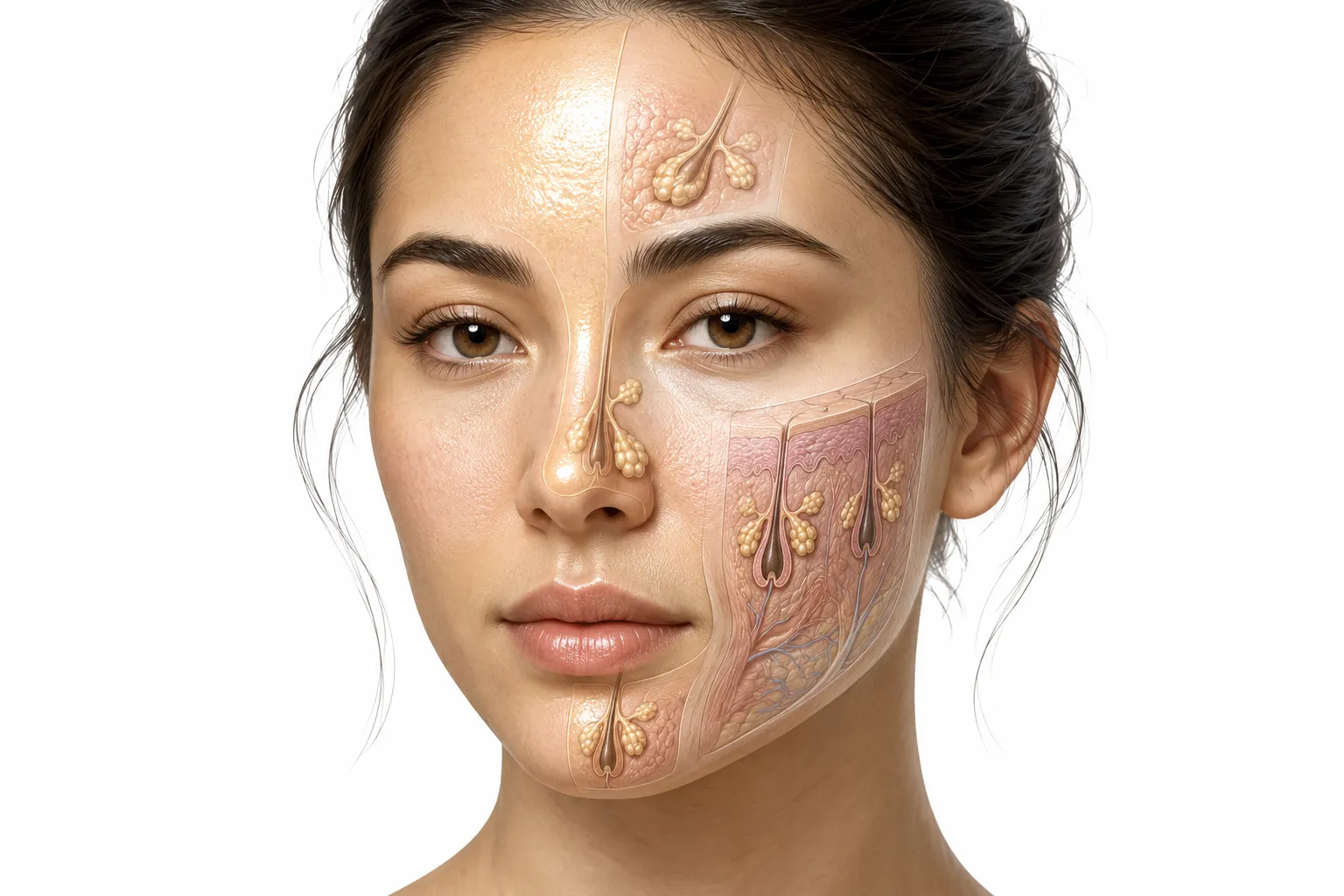
Combination skin isn't a separate category of oil production, it's simply a reflection of how unevenly sebaceous glands are distributed across the face, with the T-zone naturally carrying more of them.
Use this section to decide
Does this advice apply to me?
Find the concern or goal closest to yours, then use the fit signal to decide how much weight to give this guide.If your goal is
T-zoneDepends- Fit signal
- Possible fit
Oilier
If your goal is
CheeksUse caution- Fit signal
- Limited evidence
Drier or balanced
If your goal is
PrevalenceUsually relevant- Fit signal
- Often useful
Very common
If your goal is
Care styleUse caution- Fit signal
- Limited evidence
Zone-specific
Practical use
How to use it
Map your own T-zone and cheeks
Note oil levels and texture in each area a few hours after cleansing.
Choose zone-appropriate products
Consider a lighter formula for the T-zone and a richer one for the cheeks.
Reassess seasonally
Combination skin's balance can shift with weather and hormones, so revisit periodically.
Safety
Side effects and cautions
- Using one heavy moisturizer across the entire face
Consider a lighter formula for the T-zone and a richer one for the cheeks.
- Treating combination skin the same as oily skin
Address the drier cheek areas separately from the oilier T-zone.
- Assuming the balance never changes
Track how the T-zone and cheeks behave across seasons, since this can shift.
Fit
Who should be careful
- Those with uniformly oily or uniformly dry skin across the face
Helpful context
What else is worth knowing
Checking your own skin
A few quick self-checks for common situations.
Worth noting
Small details that can change the answer
- Gland Density. The T-zone has a naturally higher density of sebaceous glands than the cheeks.
- Very Common. Combination skin is one of the most frequently reported skin types.
- Not Fixed. The balance between zones can shift with seasons, hormones, and age.
- Zone-Specific Care. Combination skin often benefits from using different products on different areas of the face.
Combination skin means the T-zone tends to be oilier while the cheeks are drier or more balanced.
This pattern comes from an uneven distribution of sebaceous glands across the face.
Combination skin is very common and not a sign of anything being wrong.
Zone-specific care, different products for different areas, often works better than a single one-size-fits-all approach.
The balance between oily and dry areas can shift with seasons, hormones, and age.
Definition
What "combination skin" means
Combination skin describes a face where the T-zone, forehead, nose, and chin, tends to be oilier, while the cheeks are drier or closer to normal, due to an uneven distribution of sebaceous glands.
- Oilier T-zone
- Drier or balanced cheeks
- Reflects natural gland distribution, not a flaw
Explanation
Why the T-zone behaves differently
The forehead, nose, and chin have a higher concentration of sebaceous glands than the rest of the face, which means they naturally produce more oil regardless of a person's overall skin type.
Skin Type Suitability
How combination skin compares by zone
T-zone often behaves similarly to oily skin.
Cheeks can behave more like dry or normal skin.
Reflects the overall mixed pattern across the face.
Product Comparison
Choosing products for combination skin
Lightweight, oil-free moisturizer
Beginner friendlyBest for: T-zone applicationControls shine without clogging pores
Consider: May not be hydrating enough for drier cheeksRicher cream moisturizer
Beginner friendlyBest for: Cheek applicationProvides more hydration for drier areas
Consider: Can feel heavy if used across the whole faceDos Donts
Caring for combination skin
Do
Matches care to each area's actual needs.
Avoids over-drying the cheeks while still managing T-zone oil.
Avoid
Combination skin often benefits from zone-specific care.
Can leave cheeks feeling dry or tight.
Questions
Frequently asked questions
Is combination skin the most common skin type?
It's widely reported as one of the most common skin types, alongside oily and normal skin.
Should I use different moisturizers on different parts of my face?
Many people with combination skin find this helpful, using a lighter formula on the T-zone and a richer one on the cheeks.
Can combination skin change over time?
Yes, the balance between oilier and drier areas can shift with seasons, hormones, and age.
Is combination skin harder to care for than other types?
It can require more attention to zone-specific needs, but it's very manageable with the right approach.