Evidence
What the evidence shows
The principles of gentle cleansing are well-established.
Is it fragrance-free?
Yes, not just unscentedIs it sulfate-free?
Uses mild surfactantsIs it pH-balanced?
Aim for 4.5-5.5 pH
Use this section to decide
Does this advice apply to me?
Find the concern or goal closest to yours, then use the fit signal to decide how much weight to give this guide.If your goal is
Key requirementUsually relevant- Fit signal
- Often useful
Fragrance-free
If your goal is
Key ingredient to avoidUsually relevant- Fit signal
- Often useful
Sulfates
If your goal is
Skin feelUse caution- Fit signal
- Limited evidence
Clean, not tight
If your goal is
EvidenceUsually relevant- Fit signal
- Often useful
Good
Research notes already in this guide
- The mechanism of surfactant irritation and barrier damage is well-understood.
- The role of fragrances in contact dermatitis is extensively documented.
- Mild surfactants are well-established as more barrier-friendly than harsh ones.
- Individual skin variations mean that some sensitivity is personal and not universal.
Practical use
How to use it
Read the label carefully
Check for fragrance-free, sulfate-free, and pH-balanced claims. Look for mild surfactants like coco-glucoside.
Patch test new body washes
Test a small area (like your inner arm) for 24-48 hours before using a new product all over.
Listen to your skin
If your skin feels tight, red, or itchy after using a body wash, it's not the right one for you.
Safety
Side effects and cautions
- Choosing a body wash that's 'unscented' rather than fragrance-free
Unscented products can contain masking fragrances. Look specifically for fragrance-free.
- Using body washes that leave you feeling 'squeaky clean'
That squeaky feeling is your barrier being stripped. You should feel clean but not tight or dry.
- Using body wash that's not pH-balanced
The skin's natural pH is acidic. Body washes that aren't pH-balanced can disrupt your barrier.
Fit
Who should be careful
- Expecting a single best product recommendation
Worth noting
Small details that can change the answer
- Surfactant Types. Sulfates like SLS and SLES are strong surfactants that can strip sensitive skin. Mild alternatives include coco-glucoside and sodium cocoyl isethionate.
- pH Balance. The skin's natural pH is around 4.5-5.5. Body washes that are pH-balanced are less likely to disrupt the barrier.
- Fragrance Prevalence. Fragrance is the most common cause of allergic reactions to cosmetics and body products.
- Barrier Impact. The right body wash should leave the skin feeling clean but not tight or stripped, indicating the barrier remains intact.
The best body wash for sensitive skin is fragrance-free, sulfate-free, and pH-balanced.
Fragrance is the most common irritant - choose fragrance-free products explicitly.
Mild surfactants like coco-glucoside are gentler than harsh sulfates like SLS.
Avoid essential oils, even though they're natural, as they can trigger sensitivities.
Your skin should feel clean but not stripped - tightness indicates barrier damage.
Definition
What makes a body wash best for sensitive skin?
The 'best' body wash for sensitive skin isn't about a single product but a set of characteristics that support barrier health and minimize reactivity. Look for specific formulation principles rather than specific product names.
- Fragrance-free, not just unscented
- Sulfate-free or with mild surfactants
- pH-balanced (around 4.5-5.5)
- Free of alcohol, essential oils, and common irritants
- Contains barrier-supporting ingredients like glycerin or aloe
Explanation
Why fragrance matters for sensitive skin
Fragrance is the single most common contact allergen in personal care products. Even 'natural' fragrances from essential oils can trigger reactions in sensitive skin. The safest approach is to choose products that are genuinely fragrance-free - not 'unscented,' which can still contain masking fragrances.
Science
The science of gentle cleansing
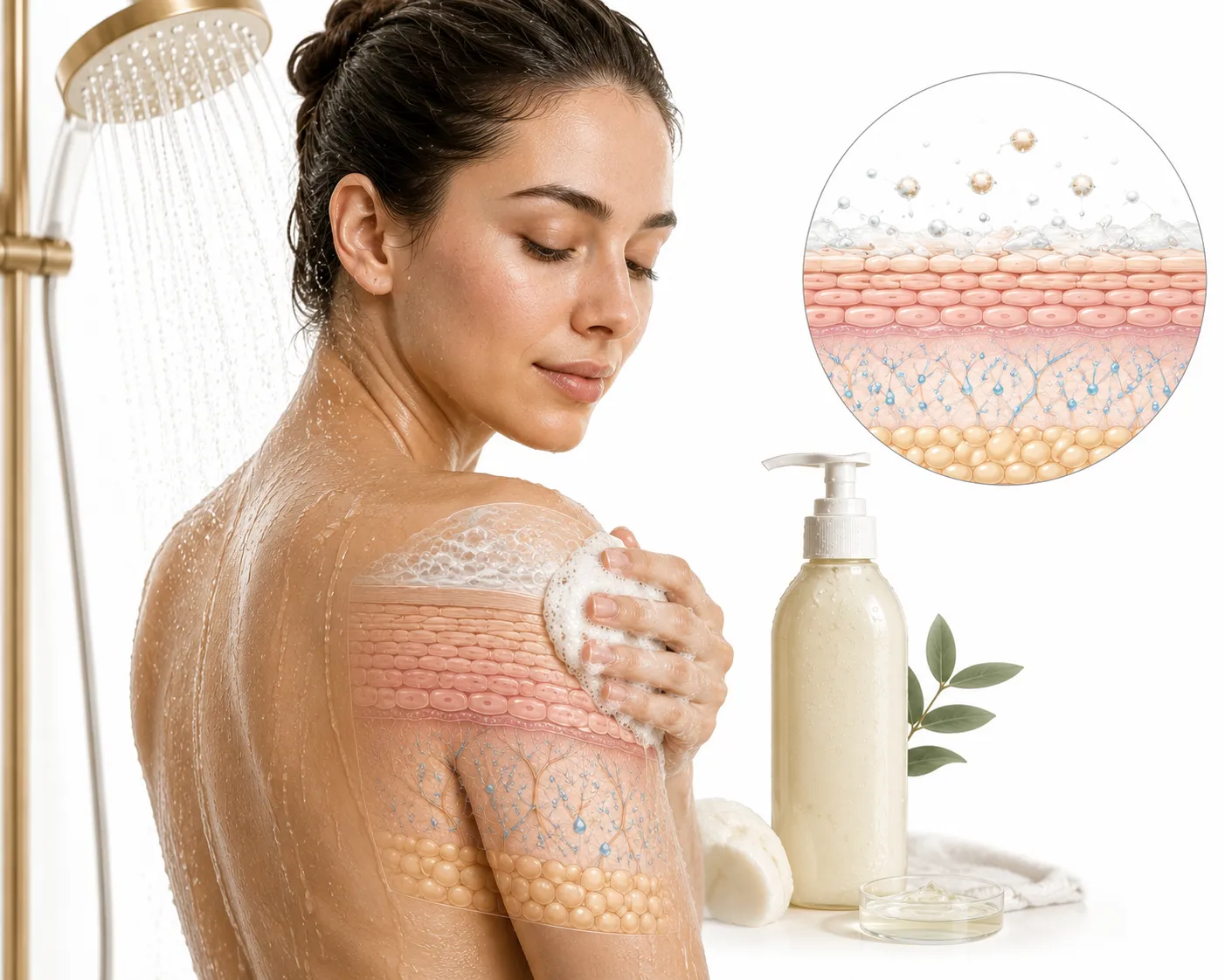
Surfactants are the cleansing agents in body wash. Harsh surfactants like sodium lauryl sulfate (SLS) are effective cleansers but can strip the skin's barrier. Mild surfactants like sodium cocoyl isethionate and lauryl glucoside are gentler because they're larger molecules that don't penetrate as deeply into the skin.
- Surfactant
- A compound that lowers the surface tension between liquids, allowing oil and water to mix. This is what cleanses the skin.
- Acid mantle
- The skin's natural pH barrier, which protects against bacteria and environmental damage.
- Transepidermal water loss
- The movement of water from the skin to the outside. Harsh cleansers increase TEWL, leading to dry, compromised skin.
Avoid
Ingredients to avoid in body wash for sensitive skin
The most common cause of contact dermatitis and irritation.
Natural but often irritating and allergenic for sensitive skin.
A harsh cleanser that can strip the barrier and cause irritation.
Drying and irritating for sensitive skin.
Questions
Frequently asked questions
Is 'unscented' body wash safe for sensitive skin?
Not always. Unscented products can have masking fragrances. Look for 'fragrance-free' instead.
Are natural body washes better for sensitive skin?
Natural doesn't mean gentle. Essential oils are common natural ingredients that frequently trigger reactions.
Can I use body wash labeled for babies?
Often yes, but check the ingredients. Some baby washes still contain fragrances or other potential irritants.
Does the type of body wash matter for conditions like eczema?
Yes. Gentle, fragrance-free, barrier-supporting body washes are recommended for eczema-prone skin.
References
Sources
The notes below are drawn from the evidence already cited in this guide. They are not a complete bibliography.
- The mechanism of surfactant irritation and barrier damage is well-understood.
- The role of fragrances in contact dermatitis is extensively documented.
- Mild surfactants are well-established as more barrier-friendly than harsh ones.
- Individual skin variations mean that some sensitivity is personal and not universal.