Evidence
What the evidence shows
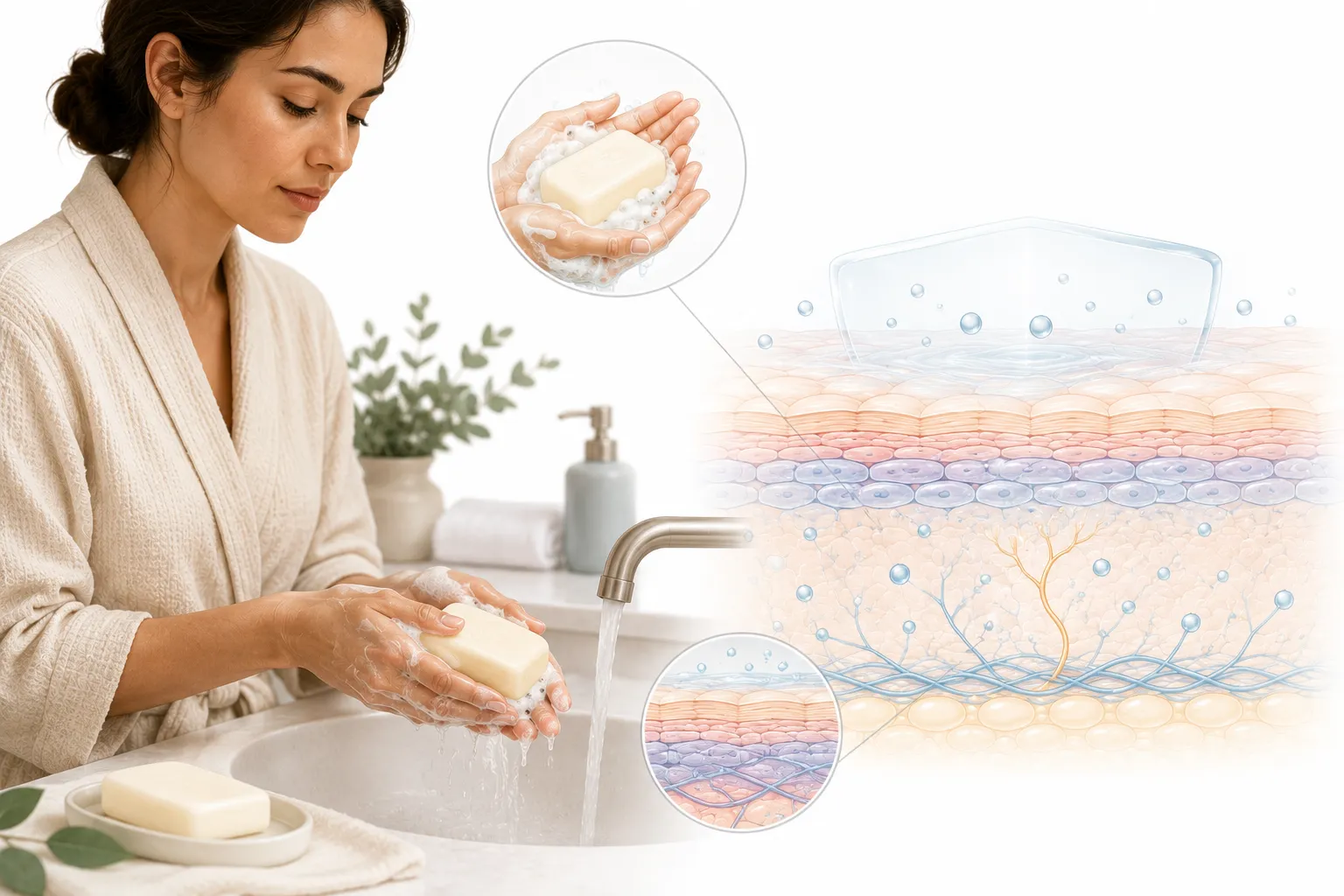
The word "soap" is a legal definition, not a quality indicator. Many of the best sensitive-skin cleansers are actually not soap at all - they're synthetic detergent bars formulated to be gentler.
Use this section to decide
Does this advice apply to me?
Find the concern or goal closest to yours, then use the fit signal to decide how much weight to give this guide.If your goal is
Best formatUsually relevant- Fit signal
- Often useful
Syndet bar
If your goal is
pHUsually relevant- Fit signal
- Often useful
5.5-6.5
If your goal is
AvoidUse caution- Fit signal
- Limited evidence
Fragrance, dyes, high pH (traditional soap)
If your goal is
Key practiceUse caution- Fit signal
- Limited evidence
Pat dry and moisturize immediately
Practical use
How to use it
Switch to a syndet bar or gentle body wash
Look for products labeled "cleansing bar" and check for pH-balanced, fragrance-free claims.
Use lukewarm water
Hot water strips the barrier; lukewarm water is gentler.
Pat dry gently and moisturize immediately
Don't rub; pat dry and apply a moisturizer to damp skin to lock in hydration.
Safety
Side effects and cautions
- Assuming natural or organic soap is gentler
Natural soaps are often high-pH and can be more irritating than synthetic syndet bars.
- Using antibacterial soap
Antibacterial soap contains harsh chemicals and disrupts the skin microbiome.
- Using bar soap on the face
Most bar soaps are too harsh for the face, even syndet bars designed for the body. Use separate products.
Fit
Who should be careful
- Those who insist on the foaming lather of traditional soap
Helpful context
What else is worth knowing
What to look for in a gentle soap
These ingredients suggest the product is designed for sensitive skin.
Draws water to the skin during the wash
Softens and soothes
Supports the barrier
Calms redness and irritation
Worth noting
Small details that can change the answer
- Skin pH Impact. After washing with a high-pH soap, it takes the skin 2-4 hours to return to its normal acidic pH.
- Syndet Difference. Syndet bars are less likely to disrupt the skin microbiome, as they don't create the same alkaline environment.
- Barrier Effect. Frequent use of alkaline soap can reduce the skin's ceramide levels, contributing to long-term dryness.
- Formulation. A good syndet bar can also include ceramides, fatty acids, or squalane to support the barrier.
Traditional soap is alkaline and disrupts the acid mantle; syndet bars are pH-balanced and gentler.
Fragrance and dyes are the most common irritants in soaps; avoid them entirely.
The best sensitive-skin cleansers are often not soap at all - they're syndet bars.
Wash with lukewarm water and pat dry to reduce friction and barrier disruption.
Use a moisturizer immediately after washing to support the barrier.
Definition
What is soap?
Soap is a salt of a fatty acid, produced by mixing fats or oils with an alkali (like sodium hydroxide). It's a surfactant that cleans by binding to oils and dirt. However, its high pH and ability to bind to the skin's natural oils can make it drying and irritating for sensitive skin.
- Can be in bar, liquid, or gel form
- Traditional soap is made from fats and lye
- Syndet bars are synthetic cleansers that are not legally "soap"
- For sensitive skin, syndet bars are significantly gentler
Science
Why traditional soap irritates sensitive skin
Traditional soap irritates sensitive skin through two main mechanisms. First, its alkaline pH disrupts the acid mantle, which is the skin's first line of defense against microbes and irritants. The acid mantle is a protective acidic film on the skin's surface. Alkaline soap temporarily removes or neutralizes this, increasing the skin's vulnerability. Second, the binding action of soap can strip the skin of natural oils, leading to a compromised barrier that allows water loss and irritant penetration.
- Acid Mantle
- A thin, acidic film on the skin's surface made of sebum and sweat that acts as a natural barrier to bacteria and irritants.
- Syndet
- A "synthetic detergent," a cleanser that doesn't use saponified oils but rather synthetic surfactants and can be pH-balanced for gentleness.
Benefits
What a syndet cleanser does for sensitive skin
Switching from standard soap to a syndet bar is transformative for sensitive skin. Here's what you can expect.
- Cleanses without a tight, stripped feeling
- Maintains the skin's natural acidic pH
- Reduces the frequency and severity of irritation episodes
- Supports the health of the skin microbiome
- Often includes moisturizing ingredients for a more comfortable feel
Avoid
What to avoid in a soap for sensitive skin
Contact allergens that serve no purpose in cleansing.
Strong surfactants that strip the skin barrier.
Unnecessary chemicals with no skin benefit.
Alkaline pH disrupts the acid mantle and damages the barrier.
Questions
Frequently asked questions
Is Dove soap good for sensitive skin?
Dove is actually a syndet bar, making it a better choice than traditional soap. However, it does contain fragrance, so you'll need the unscented version.
Can I use a syndet bar on my face?
Syndet bars are generally body products and can be too stripping for the face. Use a dedicated facial cleanser.
Is Castile soap good for sensitive skin?
Castile soap is saponified olive oil, so it's high-pH and often not ideal for sensitive skin.
How do I know if a soap is irritating my skin?
If your skin feels tight, looks red, or itches after washing, you should switch to a gentler formula.