Evidence
What the evidence shows
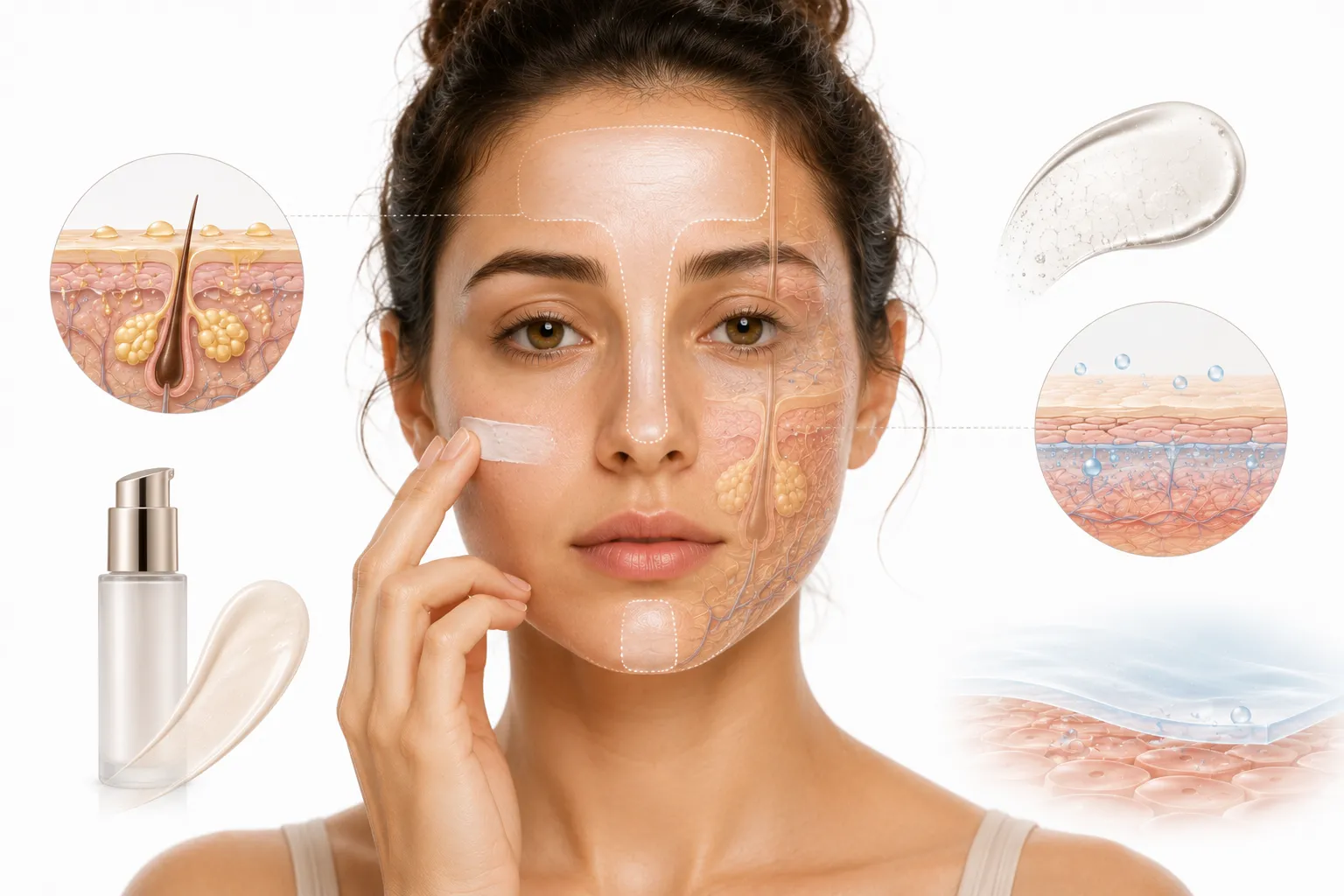
The best primer for combination skin isn't about finding one formula that works everywhere - it's about adjusting your application to suit the different needs of your skin zones.
Use this section to decide
Does this advice apply to me?
Find the concern or goal closest to yours, then use the fit signal to decide how much weight to give this guide.If your goal is
Best typeUsually relevant- Fit signal
- Often useful
Silicone-based or balancing
If your goal is
Key ingredientsUsually relevant- Fit signal
- Often useful
Dimethicone, niacinamide, hyaluronic acid
If your goal is
ApplicationUse caution- Fit signal
- Limited evidence
More on T-zone, less on cheeks
If your goal is
AvoidDepends- Fit signal
- Possible fit
Mattifying primers on the whole face
Practical use
How to use it
Choose a balanced or silicone-based primer
Look for a formula that offers oil control and hydration.
Apply strategically
More primer on the T-zone, less on the cheeks.
Allow it to set
Wait 1-2 minutes before applying foundation.
Safety
Side effects and cautions
- Using the same amount of primer everywhere
Apply more to the T-zone, less to the cheeks.
- Using a primer that's too drying or too hydrating
Choose a balanced formula and adjust application.
- Not allowing primer to set before applying foundation
Wait 1-2 minutes before applying foundation.
Fit
Who should be careful
- Very dry or very oily skin without combination patterns
Worth noting
Small details that can change the answer
- Primer Function. Primer creates a smooth canvas and helps makeup adhere better.
- Silicone Benefits. Silicone-based primers provide a smooth, pore-filling effect.
- Hydrating Primers. Hydrating primers provide moisture to dry areas.
- Application Matters. Strategic application is key for combination skin.
The best primer for combination skin balances oil control and hydration.
Silicone-based primers are excellent for smoothing the T-zone.
Hydrating primers can help the cheeks.
Application is key - apply more to the T-zone, less to the cheeks.
Consider using two different primers for very different zones.
Definition
What to look for in a primer for combination skin
The ideal primer for combination skin balances oil control with hydration.
- Silicone-based for a smooth, pore-filling effect (for the T-zone)
- Hydrating ingredients like hyaluronic acid (for the cheeks)
- Oil-control ingredients like niacinamide (for the T-zone)
- Natural or satin finish (not too matte or too dewy)
- Non-comedogenic formula that won't clog pores
- Fragrance-free and alcohol-free to avoid irritation
Product Comparison
Types of primers for combination skin
Silicone-based primers
Beginner friendlyBest for: Smoothing the T-zone and filling poresCreates a smooth canvas · Controls shine · Makes makeup last longer
Hydrating primers
Beginner friendlyBest for: Preparing dry areas for makeupAdds moisture to dry cheeks · Prevents cakey makeup
Balancing primers
Beginner friendlyBest for: The best all-in-one optionBalances oil and hydration · Works well across zones
Mattifying primers
Experienced useBest for: Very oily T-zonesStrong oil control
Consider: Can be too drying for cheeksBenefits
How to apply primer for combination skin
Application technique is just as important as product selection for combination skin.
- Start with a small amount - you can always add more
- Apply slightly more primer to the T-zone
- Apply less primer to the cheeks and eye area
- Allow the primer to set for 1-2 minutes before applying foundation
- For very different zones, consider using two different primers
Ingredient Comparison
Primer ingredients for combination skin
Dimethicone
goodBest for: Smoothing and pore-fillingSilicone that creates a smooth surface · Oil-control
Niacinamide
goodBest for: Oil regulation and barrier supportBalances oil production · Supports skin health
Hyaluronic acid
goodBest for: Hydration without oilAdds moisture to dry areas · Lightweight
Alcohol denat.
avoidBest for: Drying (to be avoided)None for combination skin
Limitations: Can dry out cheeks · May irritateDos Donts
Primer application do's and don'ts
Do
Creates the smoothest base.
Too much can cause pilling or caking.
Addresses different zone needs.
Avoid
Can make makeup slide off.
Will dry out the cheeks.
Makeup may not adhere well.
Questions
Frequently asked questions
Should I use a mattifying primer on my T-zone only?
Yes, applying a mattifying primer to the T-zone and a hydrating one to the cheeks is a great approach.
Can I use a primer on dry cheeks?
Yes, but choose a hydrating primer for the cheeks.
Does primer help with foundation longevity?
Yes, primer creates a better base for foundation and helps it last longer.
Can I skip moisturizer if I use a hydrating primer?
No - primer is not a replacement for moisturizer. Use both.