Evidence
What the evidence shows
How well research supports the causes of dry skin.
Low sebum → dry skin
Well-established linkBarrier compromise → TEWL
Consistent research findingsEnvironmental triggers
Well-documented
Use this section to decide
Does this advice apply to me?
Find the concern or goal closest to yours, then use the fit signal to decide how much weight to give this guide.If your goal is
Main issueDepends- Fit signal
- Possible fit
Barrier compromise + low sebum
If your goal is
Water lossDepends- Fit signal
- Possible fit
Higher than normal
If your goal is
Primary treatmentUse caution- Fit signal
- Limited evidence
Barrier repair
If your goal is
Recovery timeUse caution- Fit signal
- Limited evidence
Several weeks
Research notes already in this guide
- The relationship between low sebum production and dry skin is well established.
- TEWL rates consistently correlate with dry skin symptoms.
- Barrier-repair strategies are supported by extensive research.
- Climate and seasonal changes are recognized triggers in dermatological literature.
Explanation
How it works
From healthy to dry skin in four steps.
Low sebum production
Sebaceous glands produce less oil, leaving the barrier under-supported.
Barrier becomes less cohesive
Without adequate oil, the barrier cells lose their tight packing.
Water escapes
Moisture leaves the skin faster than it can be replenished.
Skin dries out
Tightness, flaking, and roughness become noticeable.
Practical use
How to use it
Switch to a gentle, soap-free cleanser
Avoid sulfates and stripping detergents that remove natural oils.
Use barrier-supporting moisturizers
Look for ceramides, cholesterol, and fatty acids.
Protect against environmental dryness
Use a humidifier in dry conditions and cover up in cold weather.
Safety
Side effects and cautions
- Using alcohol-based products that evaporate and remove moisture
Choose alcohol-free, hydrating formulas instead.
- Taking long, hot showers that strip oils
Keep showers brief and use lukewarm water.
- Assuming a richer moisturizer alone will fix everything
If the barrier is compromised, moisturizer alone isn't enough - you need barrier-supporting ingredients too.
Fit
Who should be careful
- Assuming a single moisturizer will solve everything
Worth noting
Small details that can change the answer
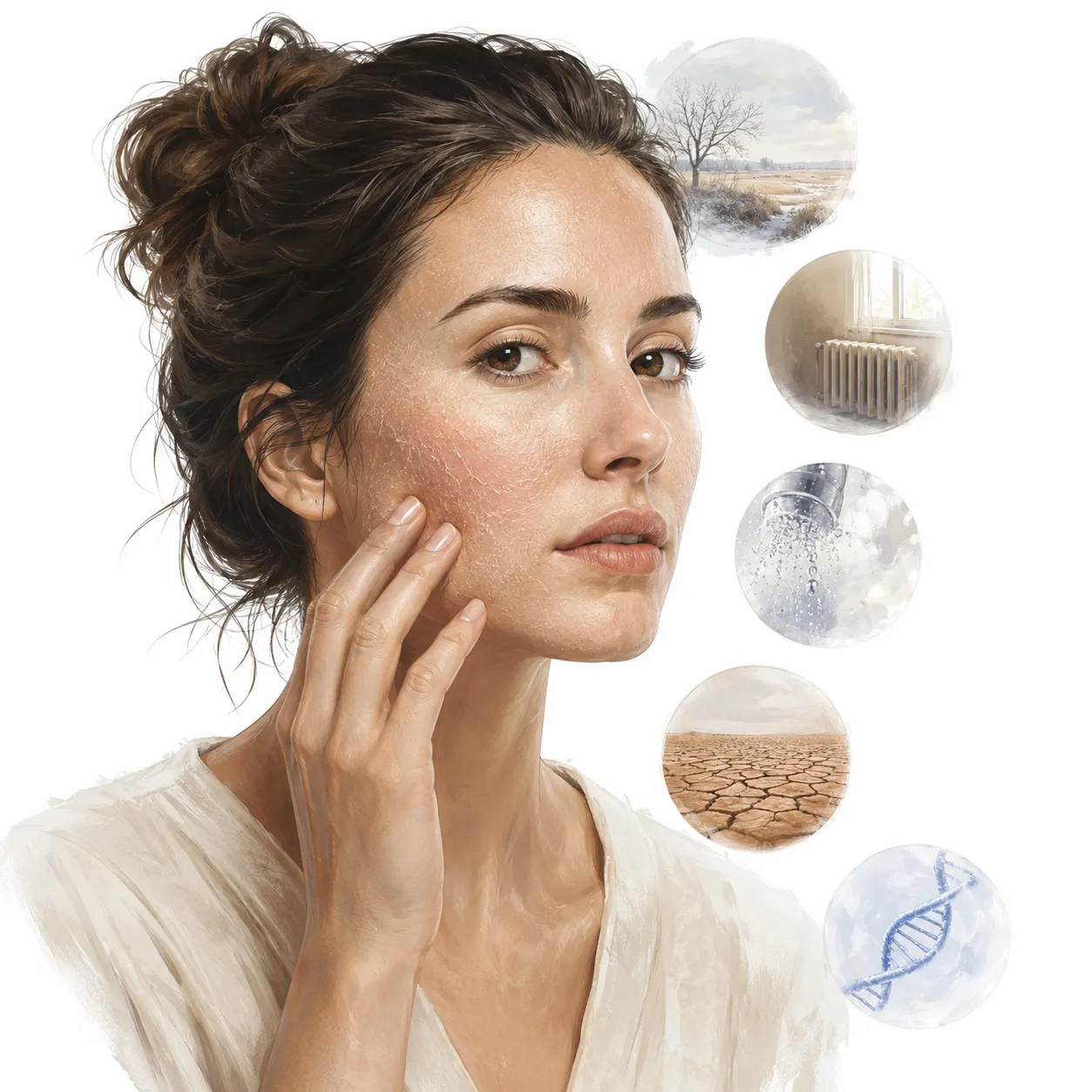
- Sebum Role. Sebum, the skin's natural oil, forms part of the barrier that prevents water loss. Low sebum production is a hallmark of dry skin.
- TEWL. Trans-epidermal water loss is the rate at which water evaporates from skin - higher rates indicate a more compromised barrier.
- Genetics. Some people have a genetic predisposition to lower sebum production and a thinner barrier.
- Climate Impact. Low humidity environments can increase TEWL by as much as 25 percent.
Dry skin is caused by a combination of low sebum and a compromised barrier that allows water loss.
The primary issue is water loss (TEWL), not just oil deficiency.
Genetics, hormones, climate, and skincare habits all influence dryness.
Treatment requires barrier repair, not just moisturizing.
Consistent, gentle care is essential for managing dry skin.
Definition
What "dry" actually means
In dermatological terms, dry skin (xerosis) is defined by low sebum production. Sebum is the skin's natural moisturizing oil, produced by sebaceous glands. It helps form the protective barrier on the skin's surface. When sebum production is low, the barrier is less effective at retaining water, and the skin loses moisture faster than it can be replenished.
Explanation
Internal causes
Genetics play a significant role in determining sebum production levels. Some people simply produce less oil than others. Hormonal changes also influence sebum production - estrogen promotes sebum production, while androgen levels affect it differently. This is why dry skin is more common in older adults and in people with certain hormonal conditions.
Explanation
External and environmental causes
External factors are often the decisive trigger that pushes skin from comfortable to uncomfortable dry. Low humidity environments, especially in winter with indoor heating, can dramatically increase water loss. Harsh cleansers that strip natural oils, long hot showers, and aggressive exfoliation are common culprits. Even sun exposure can dry out the skin over time.
Questions
Frequently asked questions
Is dry skin the same as dehydrated skin?
No - dry skin refers to low oil production, while dehydrated skin refers to low water content. They can occur together or separately.
Can dry skin be permanent?
For some people, dry skin is a chronic condition managed with consistent care; for others, it may be temporary.
Does drinking more water help dry skin?
Hydration supports overall health, but dry skin is primarily a barrier and sebum issue - drinking water alone won't fix it.
Can diet affect dry skin?
Certain nutritional deficiencies, particularly in essential fatty acids, can contribute to dry skin.
References
Sources
The notes below are drawn from the evidence already cited in this guide. They are not a complete bibliography.
- The relationship between low sebum production and dry skin is well established.
- TEWL rates consistently correlate with dry skin symptoms.
- Barrier-repair strategies are supported by extensive research.
- Climate and seasonal changes are recognized triggers in dermatological literature.