Evidence
What the evidence shows
How well-established is the science?
Oil-solubility mechanism
Well-documentedPore penetration
Consistent researchClinical efficacy
Extensive evidence
Use this section to decide
Does this advice apply to me?
Find the concern or goal closest to yours, then use the fit signal to decide how much weight to give this guide.If your goal is
SolubilityUsually relevant- Fit signal
- Often useful
Oil-soluble
If your goal is
Best forUse caution- Fit signal
- Limited evidence
Pores, blackheads
If your goal is
Typical strengthUse caution- Fit signal
- Limited evidence
0.5-2%
If your goal is
Start frequencyDepends- Fit signal
- Possible fit
2-3x weekly
Research notes already in this guide
- Salicylic acid's efficacy for acne and pore congestion is well documented in dermatological research.
- Its oil solubility and resulting ability to penetrate sebum-filled pores is a well-established mechanism.
- It is widely recommended by dermatologists as a first-line over-the-counter option for oily, acne-prone skin.
Explanation
How it works
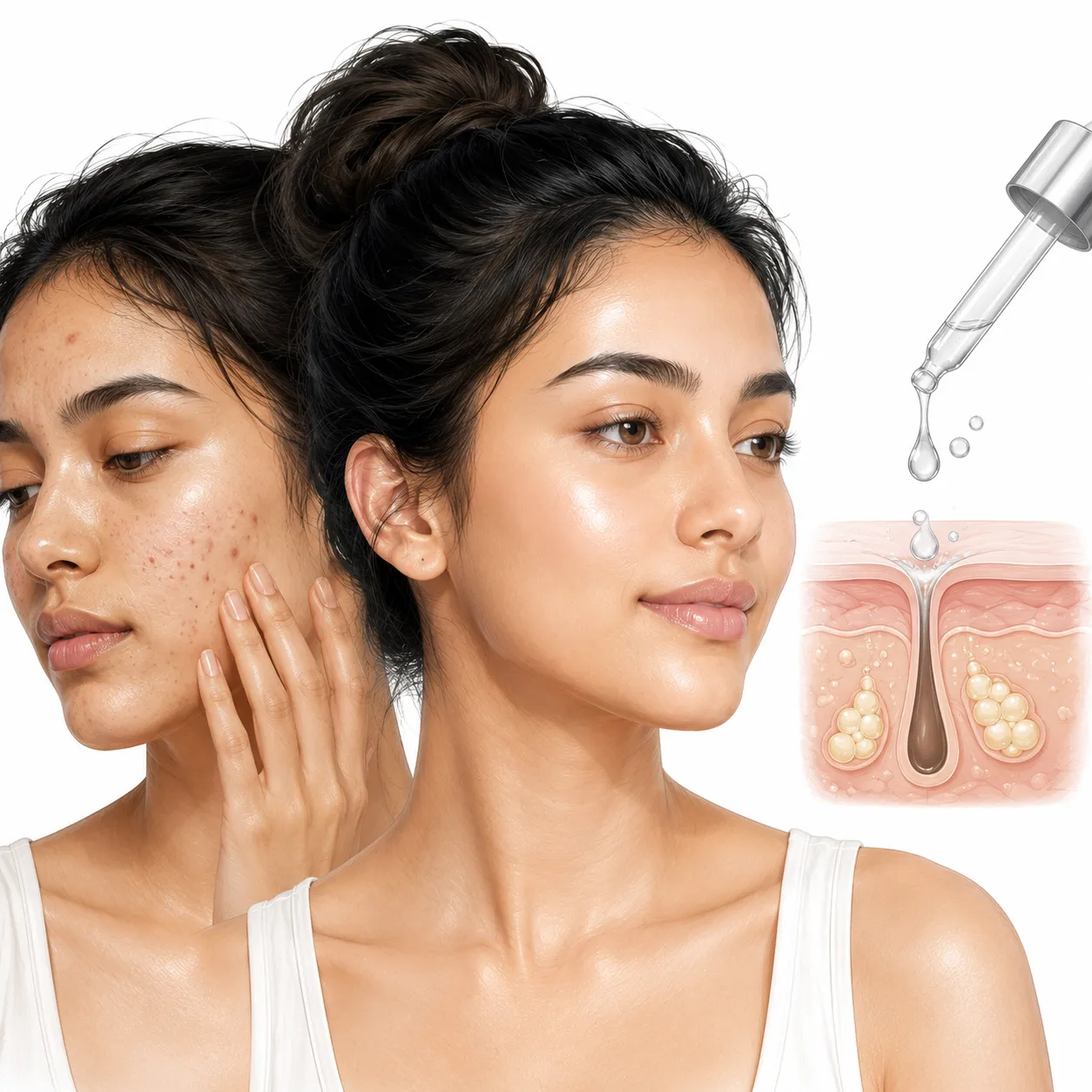
The path salicylic acid takes into a congested follicle.
Dissolves into sebum
Salicylic acid's oil solubility lets it mix directly into the sebum filling the pore.
Travels into the follicle
It moves down along with the oil, reaching areas water-soluble ingredients cannot.
Loosens buildup
It helps break the bonds holding dead skin cells and debris together within the follicle.
Congestion clears gradually
Over repeated use, this reduces the buildup that leads to blackheads and breakouts.
Practical use
How to use it
Choose your format
Start with a cleanser, toner, or leave-on serum at 0.5 to 2 percent salicylic acid.
Introduce gradually
Begin with 2 to 3 uses per week and monitor how skin responds.
Pair with hydration
Follow with a lightweight, oil-free moisturizer to support the barrier.
Safety
Side effects and cautions
- Assuming all exfoliating acids work the same way
Salicylic acid's oil solubility is what sets it apart for pore-level congestion.
- Using it daily right from the start
Build up frequency gradually, starting at 2 to 3 times per week.
- Expecting overnight results
Visible improvement in congestion typically takes several weeks of consistent use.
Fit
Who should be careful
- Those with known salicylate sensitivity
Worth noting
Small details that can change the answer
- Oil Solubility. Salicylic acid is one of the few common exfoliating acids that dissolves in oil rather than water.
- Pore-Level Action. This solubility lets it reach inside the follicle, where oily skin's congestion actually forms.
- Anti-Inflammatory. It also has mild anti-inflammatory properties, which can help calm active breakouts.
- Concentration Range. Over-the-counter formulas typically range from 0.5 to 2 percent salicylic acid.
Salicylic acid is good for oily skin primarily because it is oil-soluble, unlike most other exfoliating acids.
This lets it dissolve into sebum and reach inside the pore, where oily skin's congestion actually forms.
It helps with blackheads, closed comedones, and the appearance of enlarged pores.
Its mild anti-inflammatory properties also help with active breakouts.
Gradual introduction avoids over-exfoliation while still delivering its pore-clearing benefits.
Science
The chemistry behind the difference
Alpha hydroxy acids like glycolic acid are water-soluble, meaning they dissolve and travel most easily through the water-based parts of the skin's surface. Salicylic acid's molecular structure instead makes it lipophilic, or oil-loving, which allows it to dissolve into and move through sebum rather than being blocked by it.
- Lipophilic
- Having an affinity for oil or fat rather than water, allowing a substance to dissolve in oily environments.
- Comedone
- A clogged hair follicle formed from a mixture of sebum and dead skin cells, appearing as a blackhead or whitehead.
Benefits
Why this matters specifically for oily skin
Oily skin tends to experience a particular pattern of concerns that salicylic acid is well matched to.
- Reduces the appearance of blackheads and closed comedones
- Helps refine the look of enlarged pores over time
- Offers mild anti-inflammatory benefit for active breakouts
- Targets congestion at the follicle level, not just the surface
Questions
Frequently asked questions
Is salicylic acid stronger than other acids?
Not necessarily; its advantage is where it can go, inside oil-filled pores, rather than being inherently stronger.
Can salicylic acid unclog pores that are already blackheads?
Yes, with consistent use it can help loosen and clear existing congestion over time.
Why do dermatologists recommend salicylic acid specifically for oily skin?
Because its oil solubility targets the follicle-level congestion that is common in oily and acne-prone skin.
Does salicylic acid work on non-oily skin too?
It can, but its main advantage, dissolving through sebum, is most relevant for oilier skin types.
References
Sources
The notes below are drawn from the evidence already cited in this guide. They are not a complete bibliography.
- Salicylic acid's efficacy for acne and pore congestion is well documented in dermatological research.
- Its oil solubility and resulting ability to penetrate sebum-filled pores is a well-established mechanism.
- It is widely recommended by dermatologists as a first-line over-the-counter option for oily, acne-prone skin.