Evidence
What the evidence shows
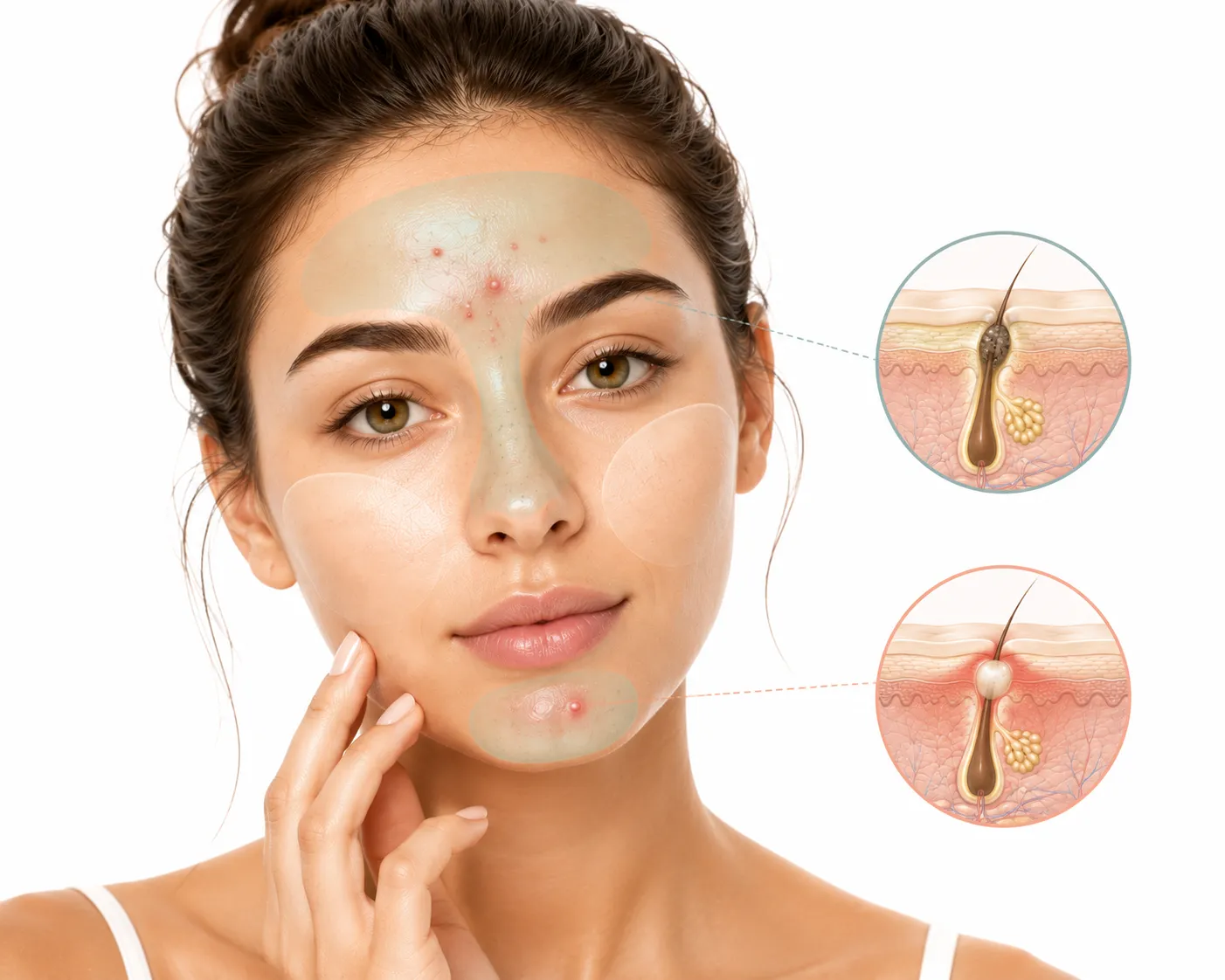
Combination skin's acne pattern follows its oil pattern - breakouts are most common where oil production is highest. The key to managing it is treating the acne without disrupting the balance in the drier areas.
Use this section to decide
Does this advice apply to me?
Find the concern or goal closest to yours, then use the fit signal to decide how much weight to give this guide.If your goal is
Acne prone?Use caution- Fit signal
- Limited evidence
Yes (T-zone)
If your goal is
Common locationsUse caution- Fit signal
- Limited evidence
Forehead, nose, chin
If your goal is
Dry areasUsually relevant- Fit signal
- Often useful
Cheeks, eye area
If your goal is
Key to managementUsually relevant- Fit signal
- Often useful
Targeted treatment + hydration
Explanation
How it works
Target oily areas
Use salicylic acid (BHA) or niacinamide on the T-zone where breakouts occur.
Hydrate dry areas
Use a moisturizer on cheeks and other dry areas, avoiding the T-zone if it's too heavy.
Avoid harsh, drying products
Harsh treatments can dry the cheeks and exacerbate sensitivity.
Balance overall
Maintain a routine that supports both zones without disrupting either.
Practical use
How to use it
Identify your skin's patterns
Note where you're oily, where you're dry, and where you break out.
Use targeted treatments
Apply acne treatments only to the T-zone; hydrate the cheeks with a moisturizer.
Maintain balance
Don't treat the whole face the same way - respect the different needs of different zones.
Safety
Side effects and cautions
- Using the same products on the whole face
Different areas of combination skin need different care.
- Using harsh acne treatments that dry out the cheeks
Treat acne only where it appears; hydrate the rest.
- Skipping moisturizer because of breakouts
Even the oily T-zone needs hydration; use a lightweight, oil-free moisturizer.
Fit
Who should be careful
- Using a one-size-fits-all acne treatment
Worth noting
Small details that can change the answer
- Acne Distribution. Acne in combination skin is usually concentrated in the T-zone.
- Oil Production. The T-zone has more sebaceous glands and produces more oil.
- Dry Areas Risk. Cheeks and eye areas are more prone to irritation and dryness.
- Treatment Need. A one-size-fits-all approach doesn't work for combination skin.
Combination skin can be acne prone, especially in the oily T-zone.
Acne in combination skin is typically concentrated where oil production is highest.
Treat acne in the T-zone without drying the cheeks.
Use a balanced routine with targeted treatments and zone-specific hydration.
Don't use a one-size-fits-all approach - your skin has different needs in different areas.
Definition
What is combination skin acne?
Acne in combination skin typically appears in the T-zone where oil production is highest. It can include blackheads, whiteheads, papules, and occasional pustules. The acne is often tied to the same factors as oily skin acne - blocked pores from oil and dead skin cells - but it's localized to the oiliest areas.
- Blackheads: common on the nose and forehead
- Whiteheads: frequently appear in the T-zone
- Papules: small red bumps that may be tender
- Occasional pustules: whiteheads with a red base
- Rarely cystic: deep, painful acne is less common in combination skin
Science
Why combination skin gets acne in the T-zone
The T-zone has a higher density of sebaceous glands than the rest of the face. This means it produces more oil, which is more likely to combine with dead skin cells to form pore blockages. When these blockages become inflamed, acne develops. The cheeks, with fewer oil glands, are less prone to blockages but more prone to dehydration and irritation from harsh treatments.
- Sebaceous Gland Density
- The number of oil-producing glands per area of skin. The T-zone has the highest density.
- Comedone
- A clogged pore formed from oil and dead skin cells, appearing as a blackhead or whitehead.
Benefits
Best ingredients for combination skin acne
A targeted approach using specific ingredients can manage acne without causing problems in dry areas.
- Niacinamide - regulates oil in T-zone, supports barrier everywhere
- Salicylic acid (BHA) - oil-soluble, targets blockages in T-zone
- Hyaluronic acid - hydrates dry areas without oil
- Ceramides - support barrier in all areas, especially dry zones
- Azelaic acid - gentle exfoliant that works on both oily and dry areas
Dos Donts
Combination skin acne do's and don'ts
Do
Avoids stripping any area of the face.
Prevents over-drying the cheeks.
Hydrates where needed, balances where not.
Avoid
Can cause irritation and barrier damage.
The dry areas will suffer most.
Dehydration can make acne worse.
Questions
Frequently asked questions
What causes acne in combination skin?
Excess oil and dead skin cells in the T-zone block pores, causing acne.
Is combination skin more acne prone than oily skin?
No, oily skin is generally more acne prone, but combination skin can still have significant breakouts in the T-zone.
Can I use salicylic acid on combination skin?
Yes, but use it mainly in the T-zone where oil and breakouts are present.
Should I use different moisturizers on different parts of my face?
Yes, you can use a lightweight moisturizer on the T-zone and a richer one on the cheeks.