Evidence
What the evidence shows
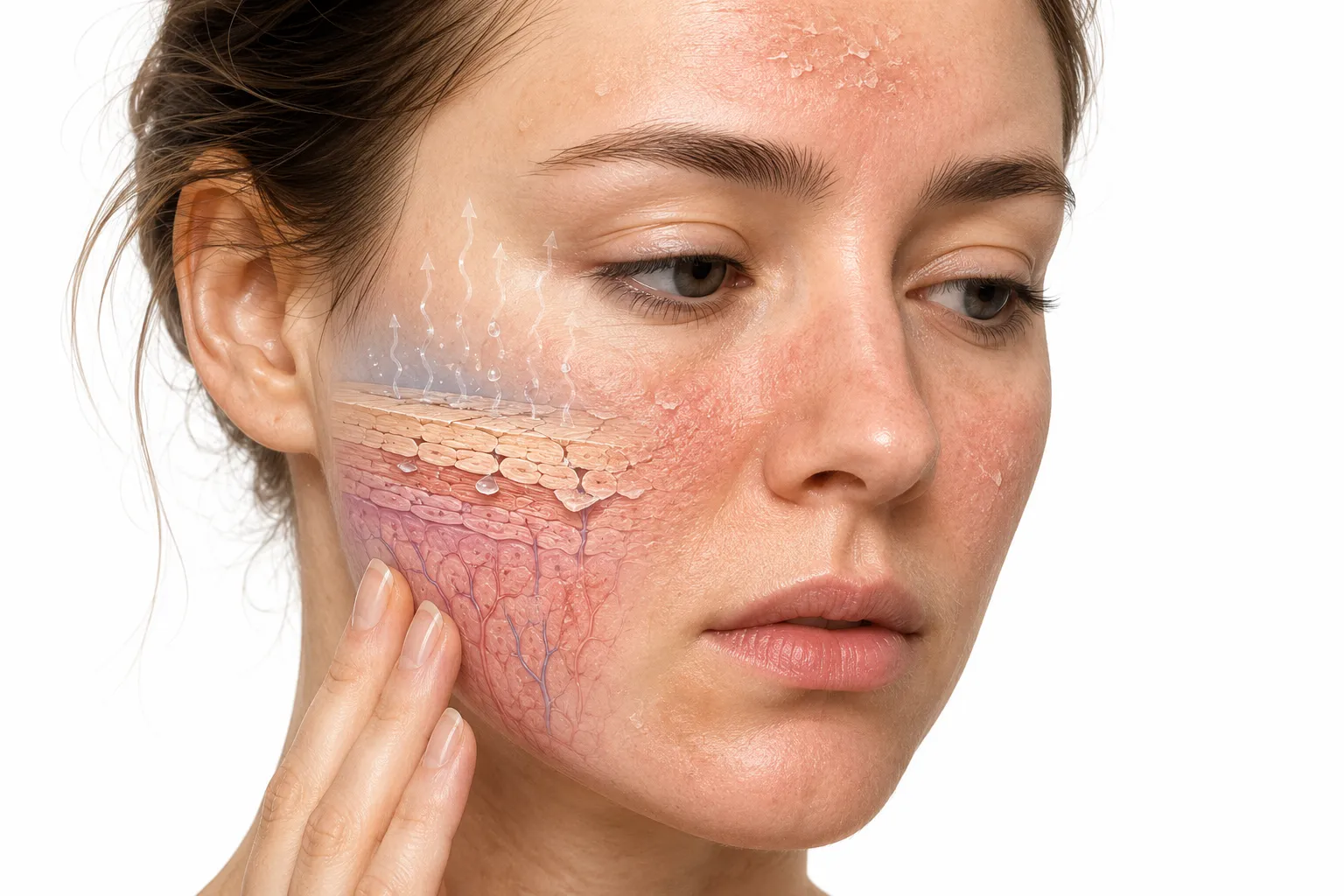
Barrier damage tends to look diffuse rather than localized, patchy redness and uneven texture spread broadly rather than a sharply defined patch, which is one of the more useful visual clues for telling it apart from a specific rash or allergic reaction.
Use this section to decide
Does this advice apply to me?
Find the concern or goal closest to yours, then use the fit signal to decide how much weight to give this guide.If your goal is
TextureDepends- Fit signal
- Possible fit
Rough, sometimes flaky
If your goal is
ToneDepends- Fit signal
- Possible fit
Patchy redness
If your goal is
Overall lookDepends- Fit signal
- Possible fit
Dull, uneven
Practical use
How to use it
Examine the pattern
Note whether changes are spread broadly and diffusely rather than localized to one spot.
Check texture and tone together
Look for the combination of rough texture, patchy redness, and dullness rather than any single change.
Respond with gentle repair
If the visual pattern matches barrier damage, simplify the routine and add barrier-repairing ingredients.
Safety
Side effects and cautions
- Mistaking barrier-damage dullness for simple tiredness
If dullness is accompanied by rough texture or patchy redness, barrier damage is worth considering.
- Assuming patchy redness is always rosacea
Barrier damage can produce similar-looking patchy redness that improves with barrier repair rather than rosacea-specific treatment.
- Trying to treat rough texture with exfoliation
Exfoliating barrier-damaged skin typically worsens the rough texture rather than smoothing it.
Fit
Who should be careful
- Diagnosing a specific underlying skin condition
Helpful context
What else is worth knowing
Barrier damage vs other skin changes
Barrier damage
Diffuse dullness, roughness, and patchy redness.
- Improves with gentle barrier repair
- Can look similar to other common issues at first glance
Localized acne
Raised, defined bumps in specific spots.
- Responds to targeted spot treatment
- Different mechanism from barrier damage
Worth noting
Small details that can change the answer
- Texture. Barrier-damaged skin often looks rougher and can appear visibly flaky, particularly in drier zones.
- Tone. Redness associated with barrier damage tends to look patchy or blotchy rather than sharply defined.
- Dullness. Reduced ability to reflect light evenly can make barrier-damaged skin look duller or more tired.
- Distribution. Barrier damage typically presents diffusely across an area rather than as a single, well-defined mark.
Barrier damage typically looks dull, rough, and patchy rather than presenting as a defined rash or mark.
Redness associated with barrier damage tends to be blotchy and diffuse rather than sharply localized.
A duller overall complexion is a common but often overlooked visual sign.
The visual pattern, spread broadly rather than localized, helps distinguish barrier damage from acne or allergic reactions.
Gentle barrier repair, not exfoliation, is the appropriate response to this visual pattern.
Explanation
The visual pattern of barrier damage
Texture, tone, and overall appearance changes.
A damaged skin barrier tends to look diffuse and general rather than localized, with rougher texture, patchy redness, and an overall duller complexion. This visual pattern reflects the underlying loss of even lipid coverage across the skin's surface.
What to look for
- Rough or slightly flaky texture, especially on the cheeks or around the nose
- Patchy, blotchy redness rather than a defined, sharp-edged mark
- An overall duller, less radiant complexion
- Uneven skin tone that seems to shift day to day
Barrier damage vs other visual skin changes
| Factor | Barrier damage | Acne | Allergic reaction |
|---|---|---|---|
| Distribution | Diffuse, patchy | Localized bumps | Often sharply defined |
| Texture | Rough, flaky | Raised, sometimes with pus | Can be raised or swollen |
| Onset | Gradual | Gradual | Often rapid |
Confirming what you are seeing
- Check whether the change is spread broadly rather than in one defined spot
- Look for a rougher, less smooth texture rather than raised bumps
- Note whether the change developed gradually rather than suddenly
Questions
Frequently asked questions
Does a damaged skin barrier always look red?
Not always, but patchy, blotchy redness is a common visual sign alongside dullness and rough texture.
How can I tell barrier damage apart from acne visually?
Barrier damage tends to look diffuse and rough, while acne presents as localized, raised bumps.
Can barrier damage make my skin look older?
Dullness and uneven texture from barrier damage can make skin look temporarily less radiant, though this is generally reversible with repair.
Will my skin go back to looking normal once the barrier heals?
Yes, texture, tone, and radiance typically improve as the barrier repairs with consistent, gentle care.