Evidence
What the evidence shows
The difference between oily and combination skin is consistency. Oily skin is oily everywhere; combination skin is oily only in certain zones. This distinction is crucial for choosing the right products.
Use this section to decide
Does this advice apply to me?
Find the concern or goal closest to yours, then use the fit signal to decide how much weight to give this guide.If your goal is
T-zone oiliness?Use caution- Fit signal
- Limited evidence
Yes
If your goal is
Cheeks oiliness?Usually relevant- Fit signal
- Often useful
No (normal or dry)
If your goal is
Different from oily skin?Usually relevant- Fit signal
- Often useful
Yes
If your goal is
Key to managementUsually relevant- Fit signal
- Often useful
Zone-specific care
Explanation
How it works
Wash your face gently
Cleanse with a gentle, pH-balanced cleanser.
Wait 30 minutes
Don't apply any products during this time.
Check your skin
Look at and feel your skin. If only the T-zone is oily, you have combination skin. If your whole face is oily, you have oily skin.
Consider the cheeks
If your cheeks are dry, normal, or slightly oily, this helps distinguish between combination and oily skin.
Practical use
How to use it
Confirm your skin type
Assess your skin after cleansing to confirm it's combination (oily T-zone, normal/dry cheeks).
Choose products for your T-zone
Use oil-controlling products only on the oily parts.
Hydrate your cheeks
Use a richer moisturizer on the cheeks, where oil isn't an issue.
Safety
Side effects and cautions
- Treating combination skin as oily skin
Only the T-zone is oily; the cheeks need gentler care.
- Using oil-control products on the whole face
This dries out the cheeks unnecessarily.
- Skipping moisturizer on the T-zone
The T-zone still needs hydration; just use a lighter formula.
Fit
Who should be careful
- Treating combination skin the same as oily skin
Worth noting
Small details that can change the answer
- T-Zone Oiliness. Combination skin has an oily T-zone but normal or dry cheeks.
- Difference From Oily Skin. Oily skin is oily across the entire face, not just the T-zone.
- Sebaceous Gland Distribution. Everyone has more oil glands in the T-zone, but the difference is more pronounced in combination skin.
- Treatment Implication. Combination skin needs zone-specific care, unlike oily skin.
Combination skin is not oily skin - only the T-zone is oily.
The cheeks in combination skin are normal or dry.
This distinction is important for choosing the right products.
Managing combination skin requires zone-specific care.
Don't treat combination skin the same as oily skin.
Definition
What is combination skin?
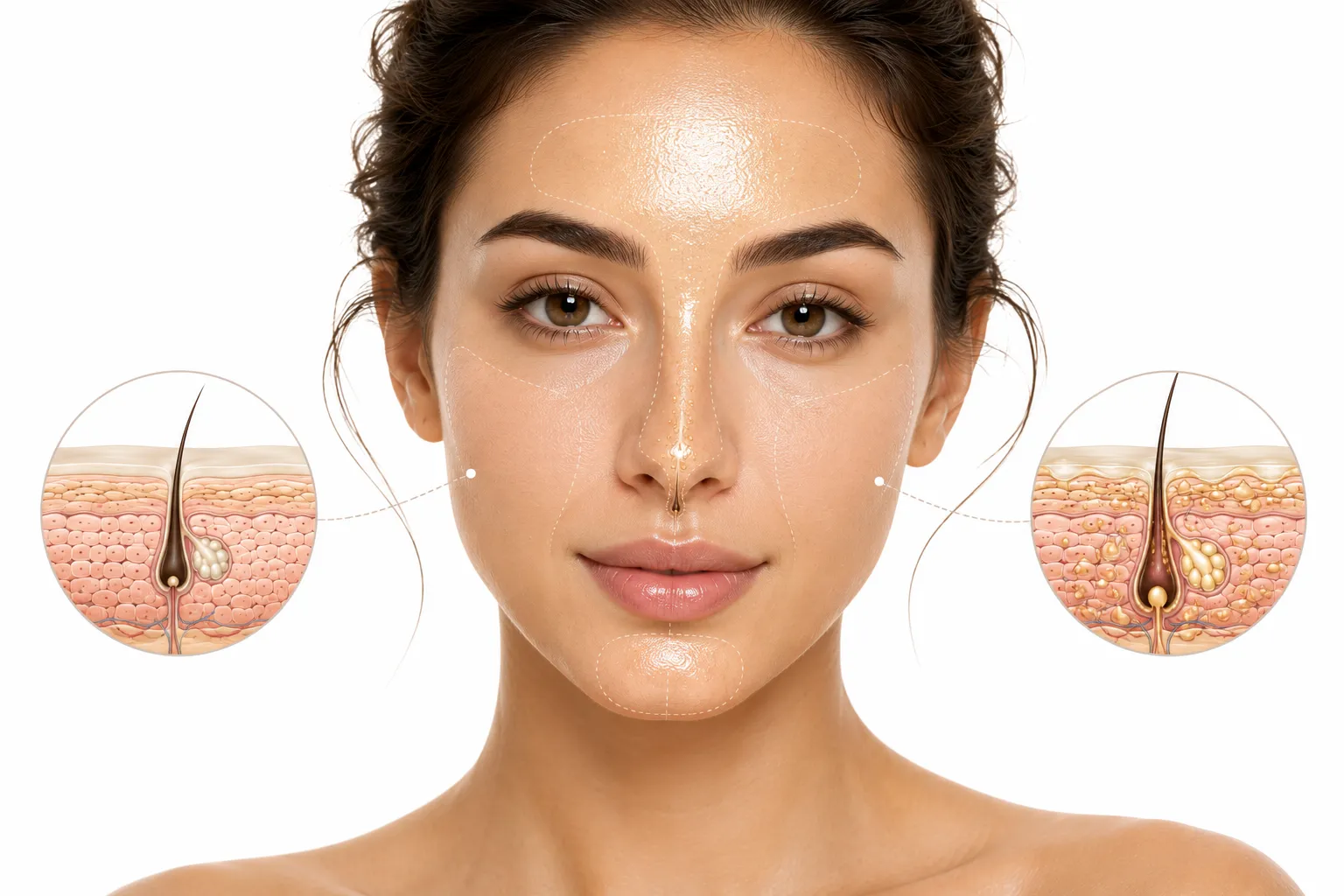
Combination skin is a skin type where the T-zone (forehead, nose, chin) is oily while the cheeks, eye area, and jawline are normal or dry. It's the most common skin type and is distinct from both oily skin (oily everywhere) and dry skin (dry everywhere).
- T-zone: Oily, prone to shine, blackheads, and enlarged pores
- Cheeks: Normal or dry, may feel tight or rough
- Eye area: Often dry, prone to fine lines
- Jawline: Can vary depending on the individual
Science
The biology of combination skin oiliness
Sebaceous glands are distributed across the entire face, but they are most concentrated in the T-zone. In combination skin, the glands in the T-zone are more active (often due to genetic and hormonal factors), producing more oil. The glands on the cheeks are less active, producing normal or minimal oil. This uneven distribution is what creates the "combination" effect.
- Sebaceous Gland Density
- The number of oil-producing glands per area of skin. The T-zone has the highest density.
- Sebum Production
- The amount of oil produced by the glands, which varies by location on the face.
Benefits
How to manage the oily T-zone in combination skin
Combination skin requires balancing the oily T-zone without drying the cheeks.
- Use a gentle cleanser that doesn't strip the cheeks
- Apply salicylic acid or niacinamide only to the T-zone
- Use a lightweight, oil-free moisturizer on the T-zone
- Use a richer moisturizer on the cheeks
- Avoid alcohol-based products that can dry the cheeks
Dos Donts
Managing combination skin oiliness do's and don'ts
Do
Avoids stripping the cheeks.
Prevents drying the cheeks.
Hydrates cheeks without over-oiling the T-zone.
Avoid
The cheeks will become dry and irritated.
Even the T-zone needs some hydration.
Different zones need different care.
Questions
Frequently asked questions
Can combination skin become oily?
No, combination skin by definition has both oily and normal/dry areas. It doesn't become fully oily.
Is combination skin just oily skin with dry patches?
No, it's a distinct skin type with different oil production across different zones.
Can I use oily skin products on my T-zone?
Yes, but use them only on the T-zone, not the whole face.
How do I know if I have oily or combination skin?
If your cheeks are also oily, you have oily skin. If they're normal or dry, you have combination skin.