Evidence
What the evidence shows
Because these signs overlap with several other skin concerns individually, it is the combination and timing, several appearing together, often after a specific trigger, that most reliably points to barrier damage rather than something else.
Use this section to decide
Does this advice apply to me?
Find the concern or goal closest to yours, then use the fit signal to decide how much weight to give this guide.If your goal is
Most distinctiveDepends- Fit signal
- Possible fit
Stinging with normal products
If your goal is
Also commonUse caution- Fit signal
- Limited evidence
Tightness, redness, flaking
If your goal is
Confirms damageUsually relevant- Fit signal
- Often useful
2+ signs together
Practical use
How to use it
Track your specific signs
Note which of the common signs, stinging, tightness, redness, flaking, apply to you right now.
Identify likely triggers
Consider recent changes in products, weather, or routine that may have contributed.
Respond early
Simplify your routine and add barrier-repairing ingredients as soon as multiple signs appear together.
Safety
Side effects and cautions
- Treating a single sign, like dryness, in isolation
Consider whether other signs like stinging or redness are also present before deciding on a treatment approach.
- Assuming redness always means rosacea or an allergy
Redness combined with other barrier-damage signs points more specifically to a compromised barrier.
- Waiting for severe symptoms before acting
Addressing early signs like mild stinging or tightness can prevent more significant barrier damage.
- Stinging or burning
- Persistent tightness
- Redness or irritation
- Flaking or rough texture
Fit
Who should be careful
- Diagnosing based on a single symptom alone
Worth noting
Small details that can change the answer
- Tolerance. Stinging or burning with normally well-tolerated products is one of the most distinctive signs of barrier damage.
- Texture. Rough, flaky texture often accompanies barrier damage due to increased water loss.
- Redness. Increased redness reflects heightened irritation and inflammation associated with a compromised barrier.
- Clustering. These signs typically appear together rather than in isolation, which helps distinguish barrier damage from other single-symptom issues.
The main signs of barrier damage include stinging, tightness, redness, flaking, and dullness.
These signs typically appear together rather than as a single isolated symptom.
Stinging with normally well-tolerated products is one of the most distinctive indicators.
Signs beginning after a specific trigger, like a new active ingredient, point more clearly to barrier damage.
Severe or long-standing symptoms may indicate an underlying condition and are worth professional evaluation.
The main signs of a damaged skin barrier
- Stinging, burning, or tingling with normally well-tolerated products
- Persistent tightness that does not resolve with moisturizing
- Increased redness or visible irritation
- Rough, flaky, or uneven texture
- A duller overall complexion
- Heightened sensitivity to weather, wind, or temperature changes
Explanation
Why these particular signs occur
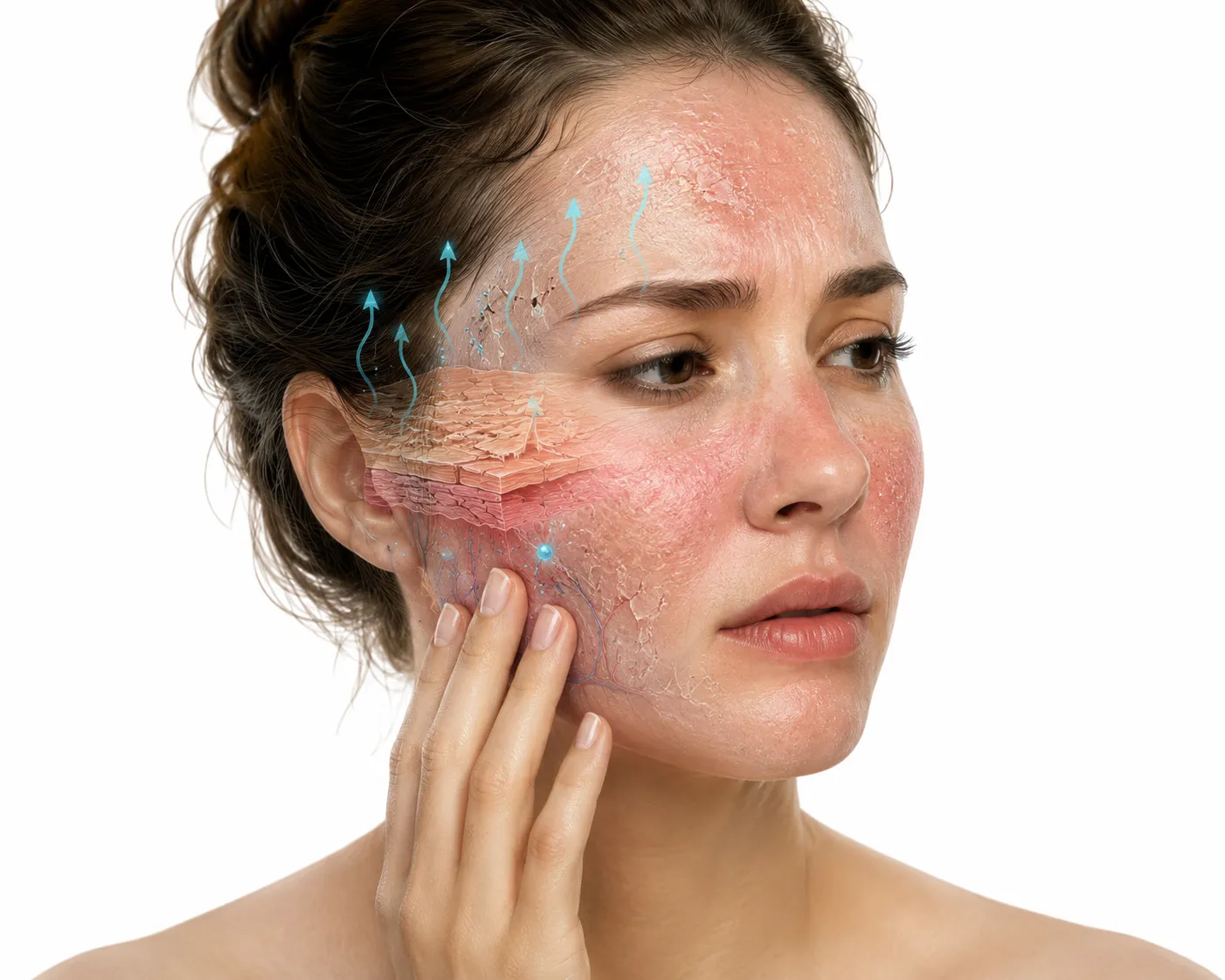
Each of these signs traces back to the same underlying issue: a compromised lipid matrix that allows water to escape more easily and irritants to penetrate more readily. Stinging reflects increased irritant penetration, tightness and flaking reflect water loss, and redness reflects the resulting inflammation.
When signs suggest something beyond typical barrier damage
- Symptoms present since early childhood, suggesting a chronic condition like eczema
- Signs confined to a very specific, sharply defined area
- Swelling, blistering, or oozing, which may indicate infection or a more serious reaction
Confirming the pattern
- Check whether at least two or more signs are present together
- Consider whether signs began after a specific trigger, like a new active ingredient
- Note whether signs have developed gradually over days to weeks
Questions
Frequently asked questions
What is the most common sign of a damaged skin barrier?
Stinging or burning with products that were previously well tolerated is one of the most common and distinctive signs.
Can a damaged skin barrier cause dullness?
Yes, reduced moisture retention and a rougher surface texture can both contribute to a duller overall appearance.
How many signs do I need to have to confirm barrier damage?
Two or more signs appearing together, especially after a known trigger, more reliably suggest barrier damage than a single symptom alone.
Do these signs mean the same thing as sensitive skin?
Not necessarily; barrier damage is often a temporary, triggered state, while sensitive skin can be a longer-standing baseline characteristic.