Evidence
What the evidence shows
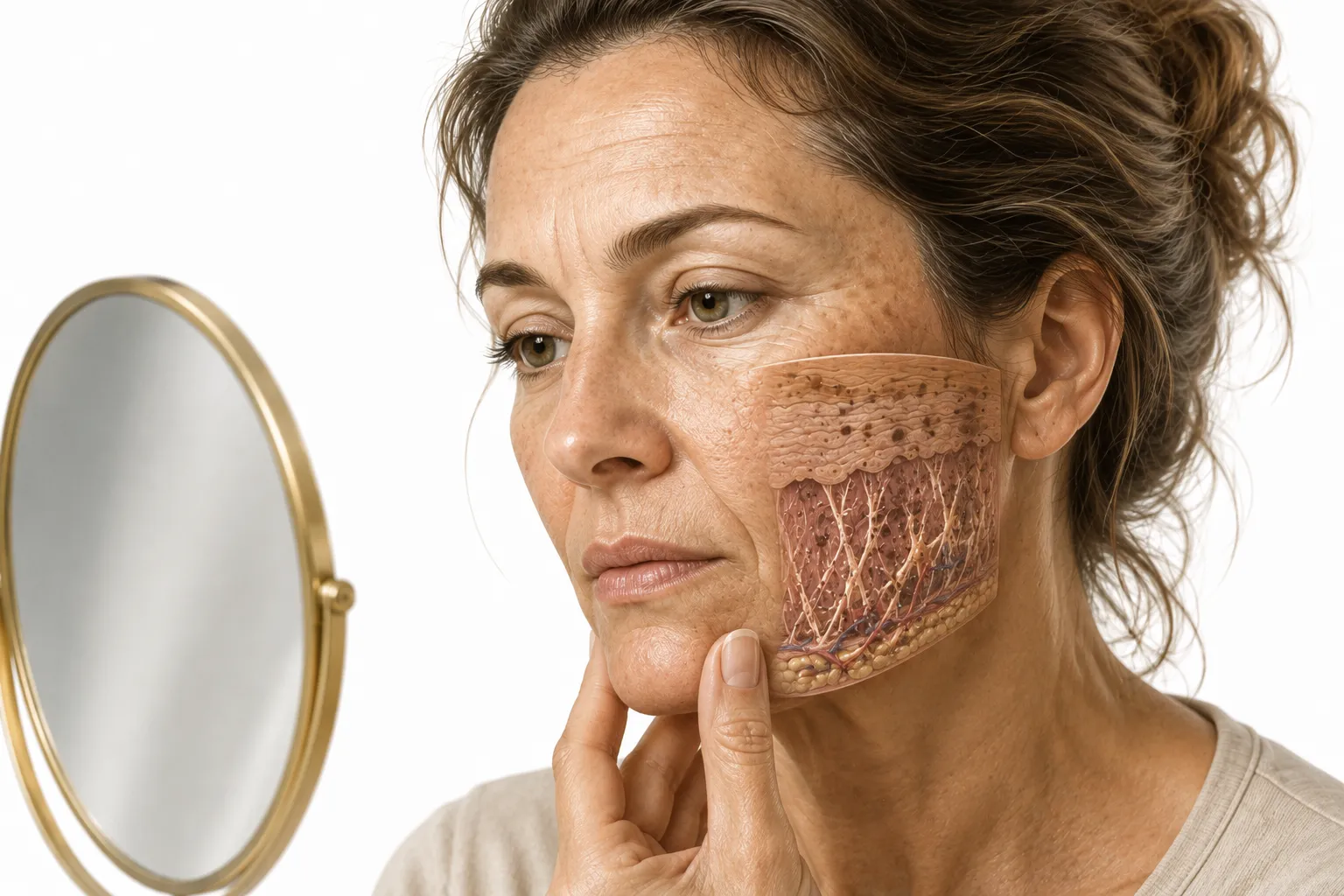
The signs of sun-damaged skin are a combination of textural, color, and structural changes that are distinct from the signs of natural aging.
Do you have fine lines around your eyes?
Lines around the eyes are a common early sign.Do you have any dark spots?
Age spots are a classic sign of sun damage.Is your skin texture rough or uneven?
Roughness can indicate actinic elastosis.
Use this section to decide
Does this advice apply to me?
Find the concern or goal closest to yours, then use the fit signal to decide how much weight to give this guide.If your goal is
WrinklesUsually relevant- Fit signal
- Often useful
Fine lines, deep creases
If your goal is
PigmentationDepends- Fit signal
- Possible fit
Spots, uneven tone
If your goal is
TextureDepends- Fit signal
- Possible fit
Rough, leathery
If your goal is
CapillariesDepends- Fit signal
- Possible fit
Broken, visible
Research notes already in this guide
- Dermatologists use scales like the Glogau Photoaging Scale to classify sun damage.
- The signs of sun damage are well-documented in clinical studies and textbooks.
- Patients' self-assessments often align with dermatologists' evaluations of photoaging.
Expected results
Results and timeframe
The signs are a visual timeline of your sun exposure.
Practical use
How to use it
Examine your skin regularly
Look for changes in color, texture, and shape on all areas of your skin.
Use sunscreen every day
Protect your skin from further damage with SPF 30 or higher.
Consult a dermatologist
If you notice any new or changing lesions, see a dermatologist for evaluation.
Safety
Side effects and cautions
- Confusing sun damage with natural aging
Sun damage is accelerated aging caused by UV exposure; the two are related but distinct.
- Assuming that tanning is protective
A tan is a visible sign of UV damage.
- Only looking at the face
Sun damage can appear on any area of the skin that is exposed to the sun.
Fit
Who should be careful
- Those who are already under dermatological care for skin cancer
Worth noting
Small details that can change the answer
- Actinic Elastosis. It is the thickening of elastic fibers in the skin, giving it a yellowed, weathered appearance.
- Solar Lentigines. The medical name for age spots, caused by a localized increase in melanin production.
- Actinic Keratosis. Rough, scaly patches that can be a precursor to skin cancer.
- Favre-Racouchot Syndrome. A combination of comedones and elastosis in the skin.
Sun-damaged skin looks like wrinkles, pigmentation changes, and a rough texture.
They are distinct from natural aging, though they accelerate it.
Recognizing these signs can help you take protective measures.
Early identification can help prevent the development of skin cancer.
Definition
Understanding the visual signs of sun-damaged skin
Sun-damaged skin can manifest in several ways, each with a different underlying cause. Some changes are pigmentation-related, some are structural, and some are textural. Recognizing these signs is the first step in understanding your skin's health and history.
- Fine lines and wrinkles, particularly around the eyes and mouth
- Uneven pigmentation, including age spots and freckles
- Rough, leathery texture with a loss of elasticity
- Broken capillaries and redness
- A yellowed or sallow tone due to elastosis
Explanation
How sun damage changes skin color and tone
Melanocytes respond to UV exposure by producing more melanin, which results in a tan. Chronic UV exposure can cause these melanocytes to become hyperactive, producing patches of excess pigment. At the same time, damage to the DNA can lead to a loss of pigment in other areas, resulting in a mottled or uneven tone.
Benefits
Why identifying sun damage matters
Recognizing sun-damaged skin is more than an aesthetic exercise. It is a way to understand your skin's history and to motivate protective measures. It can also help you identify potentially dangerous lesions early.
- Allows you to take protective measures early
- Helps you choose appropriate treatments
- Can help identify early signs of skin cancer
- Encourages a proactive approach to skin health
Questions
Frequently asked questions
At what age does sun-damaged skin start to show?
It depends on sun exposure, but signs often become visible in the 30s and 40s.
Is sun-damaged skin a sign of cancer?
Not necessarily, but it can be a risk factor. Any new or changing lesions should be evaluated by a dermatologist.
Can sun-damaged skin look like acne?
It can, though the comedones in Favre-Racouchot syndrome are distinct from acne.
How can I tell if I have sun-damaged skin?
Look for the signs described here, and consult a dermatologist for a professional evaluation.
References
Sources
The notes below are drawn from the evidence already cited in this guide. They are not a complete bibliography.
- Dermatologists use scales like the Glogau Photoaging Scale to classify sun damage.
- The signs of sun damage are well-documented in clinical studies and textbooks.
- Patients' self-assessments often align with dermatologists' evaluations of photoaging.