Evidence
What the evidence shows
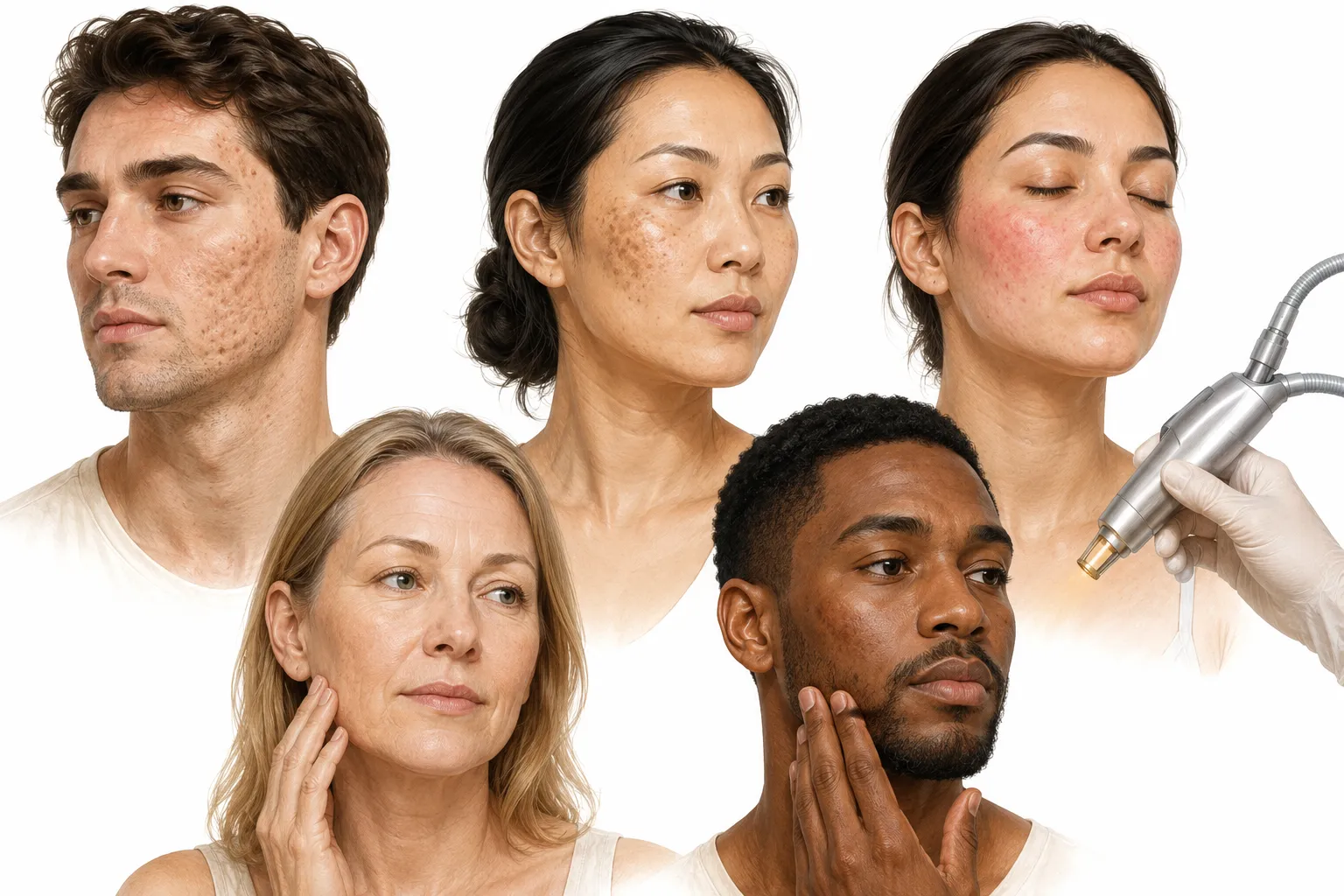
Laser effectiveness depends on matching the light's wavelength to the target's color - hemoglobin absorbs different wavelengths than melanin, which absorbs different wavelengths than collagen.
Use this section to decide
Does this advice apply to me?
Find the concern or goal closest to yours, then use the fit signal to decide how much weight to give this guide.If your goal is
Best ForUsually relevant- Fit signal
- Often useful
Vascular, pigmentation, scars
If your goal is
RequiresDepends- Fit signal
- Possible fit
Medical professional
If your goal is
RisksDepends- Fit signal
- Possible fit
Real and procedure-dependent
If your goal is
EvidenceUsually relevant- Fit signal
- Often useful
Strong for selected conditions
Research notes already in this guide
- Vascular lasers are considered first-line treatment for port-wine stains and certain other vascular lesions.
- Q-switched lasers are highly effective for tattoo removal and certain pigmentation disorders.
- Fractional lasers show strong evidence for improving acne scarring and photoaging.
- Laser hair removal has been extensively studied and has consistently high effectiveness.
Practical use
How to use it
Consult a qualified medical professional
Always see a dermatologist or trained specialist for a proper assessment of your condition and laser suitability.
Understand the risks and benefits
Get a clear explanation of the expected outcomes, recovery time, and potential risks.
Follow pre- and post-treatment protocols carefully
Adherence to instructions - especially sun avoidance and skin care - is critical for safety and results.
Safety
Side effects and cautions
- Assuming one laser treats all conditions
Each condition requires a specific laser wavelength and protocol.
- Undergoing treatment without a proper consultation
Medical assessment and skin typing are essential to determine suitability.
- Ignoring pre- and post-treatment care
Proper preparation and aftercare significantly affect outcomes and safety.
- Redness and swelling
Very common · Typically resolves within hours to days
- Pigmentation changes
Occasional · Sun avoidance and medical follow-up
- Scarring
Rare · Immediate medical attention if significant
- Infection
Rare · Proper wound care and hygiene
Fit
Who should be careful
- People with active infections, certain skin cancers, or unrealistic expectations
Worth noting
Small details that can change the answer
- Vascular Lasers. Yellow-green wavelengths target hemoglobin in blood vessels.
- Pigment Lasers. Green or red wavelengths target melanin in pigmented lesions.
- Ablative Lasers. CO2 and erbium lasers remove layers of skin for resurfacing.
- Contraindication. Lasers should not be used on active infections, cancer, or during pregnancy.
Lasers treat specific conditions through selective photothermolysis - matching wavelength to target.
Vascular, pigmentation, scarring, and hair conditions are the most common indications.
Not all lasers treat all conditions; correct device selection is essential.
Laser treatments are medical procedures with real risks, not routine skincare.
Professional assessment and consultation are always required.
Definition
What are medical lasers in dermatology?
Medical lasers are devices that produce focused beams of a specific wavelength of light. In dermatology, they're used to treat conditions by selectively heating target tissue - a process called selective photothermolysis. The wavelength determines what the laser targets, the pulse duration determines how much it heats it, and the energy level determines how much damage it does.
- Pulsed dye lasers for vascular conditions
- Q-switched lasers for pigmentation
- Ablative lasers for skin resurfacing
- Diode and alexandrite lasers for hair removal
- Fractional lasers for scarring and textural issues
Explanation
Why laser choice matters
Different skin structures absorb different wavelengths of light. Hemoglobin absorbs shorter wavelengths in the yellow-green range, so vascular lasers use these wavelengths to heat blood vessels. Melanin absorbs longer wavelengths, so pigment lasers typically use red or near-infrared light. And water absorbs in the mid-infrared range, so ablative lasers target the water in skin cells. The right match of wavelength, pulse duration, and energy determines whether treatment is effective or simply heats the wrong tissue.
Risks
Risks and considerations
Laser treatments are medical procedures and come with real risks. The most common are temporary redness, swelling, and discomfort. More serious risks include burns, scarring, pigmentation changes, and, rarely, paradoxical worsening of the condition.
- Temporary redness and swelling (common)
- Pigmentation changes (temporary or permanent)
- Scarring (rare with proper settings)
- Infection (risk with ablative procedures)
Questions
Frequently asked questions
Can lasers treat skin cancer?
Some lasers can treat precancerous conditions, but full skin cancers typically require surgical removal.
Is laser treatment painful?
Most patients experience mild discomfort, often described as a rubber band snapping against the skin.
How many laser sessions are needed?
It depends on the condition - vascular and pigmentation issues may need 1-3 sessions, while scars and hair removal often require multiple.
Can lasers be used on all skin types?
Yes, but the laser type and settings must be carefully adjusted for darker skin tones to avoid pigmentation changes.
References
Sources
The notes below are drawn from the evidence already cited in this guide. They are not a complete bibliography.
- Vascular lasers are considered first-line treatment for port-wine stains and certain other vascular lesions.
- Q-switched lasers are highly effective for tattoo removal and certain pigmentation disorders.
- Fractional lasers show strong evidence for improving acne scarring and photoaging.
- Laser hair removal has been extensively studied and has consistently high effectiveness.