Evidence
What the evidence shows
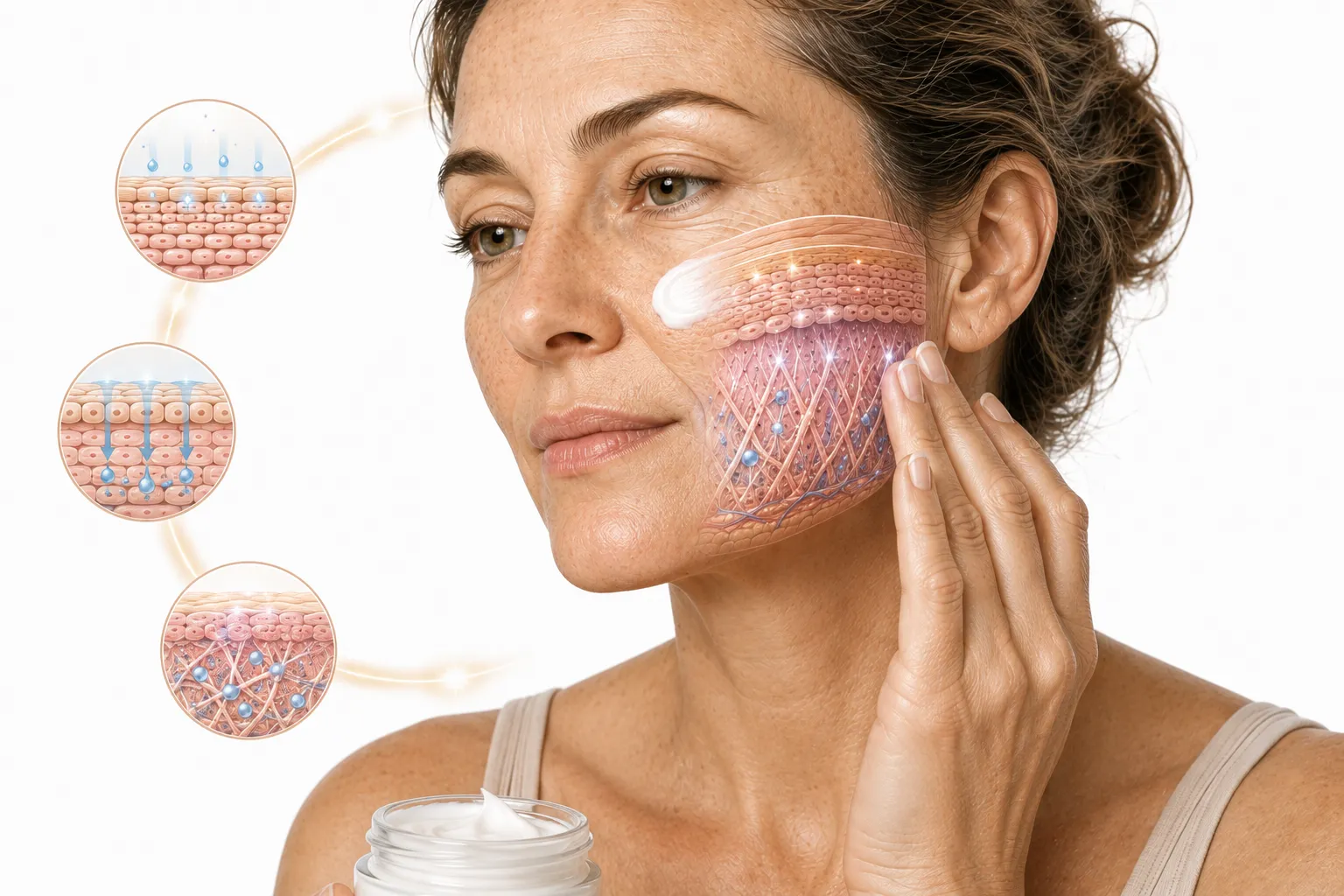
The best moisturizer for sun-damaged skin does more than hydrate; it actively supports barrier repair by providing the structural lipids (ceramides, fatty acids, cholesterol) that the skin needs to rebuild.
Use this section to decide
Does this advice apply to me?
Find the concern or goal closest to yours, then use the fit signal to decide how much weight to give this guide.If your goal is
CeramidesUsually relevant- Fit signal
- Often useful
Essential for barrier repair
If your goal is
NiacinamideUsually relevant- Fit signal
- Often useful
Supports DNA repair and barrier function
If your goal is
Hyaluronic acidDepends- Fit signal
- Possible fit
Excellent humectant
If your goal is
AntioxidantsDepends- Fit signal
- Possible fit
Neutralizes free radicals
Research notes already in this guide
- Ceramide-containing moisturizers improve barrier function in photodamaged skin.
- Niacinamide has been shown to improve DNA repair and reduce UV-induced immunosuppression.
- Antioxidants in moisturizers help neutralize free radicals generated by UV exposure.
- Consistent moisturizer use improves hydration, elasticity, and barrier function in photodamaged skin.
Expected results
Results and timeframe
Consistent use morning and night is key to seeing improvement.
Practical use
How to use it
Choose a moisturizer with barrier-repairing ingredients
Look for ceramides, fatty acids, and niacinamide in the ingredient list.
Apply to slightly damp skin
This helps lock in more hydration and improves absorption.
Use morning and night
Consistent use is essential for barrier repair and hydration.
Safety
Side effects and cautions
- Using the same moisturizer as before sun damage
Photodamaged skin has different needs, requiring barrier repair ingredients.
- Skipping moisturizer to avoid breakouts
Dehydrated skin produces more oil to compensate, so moisturizing is essential.
- Choosing a product based on texture rather than ingredients
Focus on barrier-repairing ingredients, not just how a product feels.
- Irritation
Common · Avoid fragrances and alcohol
- Breakouts
Occasional · Choose non-comedogenic formulas
- Worsened barrier function
Occasional · Focus on barrier repair ingredients
Fit
Who should be careful
- Reversing deep photodamage alone
Worth noting
Small details that can change the answer
- Barrier Repair. Sun-damaged skin has lower levels of ceramides, making barrier repair essential.
- Hydration Needs. Photodamaged skin is often chronically dehydrated due to barrier disruption.
- Antioxidant Value. Moisturizers with antioxidants help neutralize free radicals from sun exposure.
- Texture Matters. Rich, creamy textures are generally better for photodamaged skin than lightweight gels.
Sun-damaged skin needs a moisturizer that repairs the barrier and provides hydration.
Look for ceramides, fatty acids, niacinamide, and humectants in your moisturizer.
Avoid fragrances, alcohol, and essential oils that can irritate photodamaged skin.
Rich, creamy textures are often better than lightweight gels for photodamaged skin.
Definition
What to look for in a moisturizer for sun-damaged skin
The best moisturizer for photodamaged skin addresses three needs: hydration, barrier repair, and protection.
- Humectants (hyaluronic acid, glycerin): attract water to the skin
- Emollients (ceramides, fatty acids): repair the barrier and smooth the skin
- Occlusives (shea butter, squalane): lock in moisture and prevent water loss
- Antioxidants (niacinamide, vitamin C, green tea): protect against free radicals
Product Label Explainer
Reading the label: what ingredients matter most for sun-damaged skin
CeramidesLipids that repair the skin barrier, which is often damaged by UV exposure.goodNiacinamideVitamin B3 that supports DNA repair, reduces inflammation, and improves barrier function.goodHyaluronic acidA humectant that holds up to 1000 times its weight in water.goodFragrance or essential oilsCan irritate compromised, photodamaged skin.avoidShopping Guide
What to avoid in a moisturizer for sun-damaged skin
Can irritate sensitive, photodamaged skin and cause further inflammation.
Drying and can compromise the barrier further.
Can cause sensitivity and irritation in compromised skin.
Some oils and thickeners can clog pores, even on dry skin.
Questions
Frequently asked questions
Can a moisturizer reverse sun damage?
No, but it can support barrier repair, improve hydration, and reduce the appearance of photodamage.
Is it better to use a cream or a lotion for sun-damaged skin?
Creams are generally better because they provide more moisture and barrier support.
Should I use a moisturizer with SPF?
Yes, a moisturizer with SPF is convenient for daytime, but ensure it provides broad-spectrum protection.
How soon will I see results from a moisturizer?
Hydration improves within days, but barrier repair takes weeks to months of consistent use.
References
Sources
The notes below are drawn from the evidence already cited in this guide. They are not a complete bibliography.
- Ceramide-containing moisturizers improve barrier function in photodamaged skin.
- Niacinamide has been shown to improve DNA repair and reduce UV-induced immunosuppression.
- Antioxidants in moisturizers help neutralize free radicals generated by UV exposure.
- Consistent moisturizer use improves hydration, elasticity, and barrier function in photodamaged skin.