Evidence
What the evidence shows
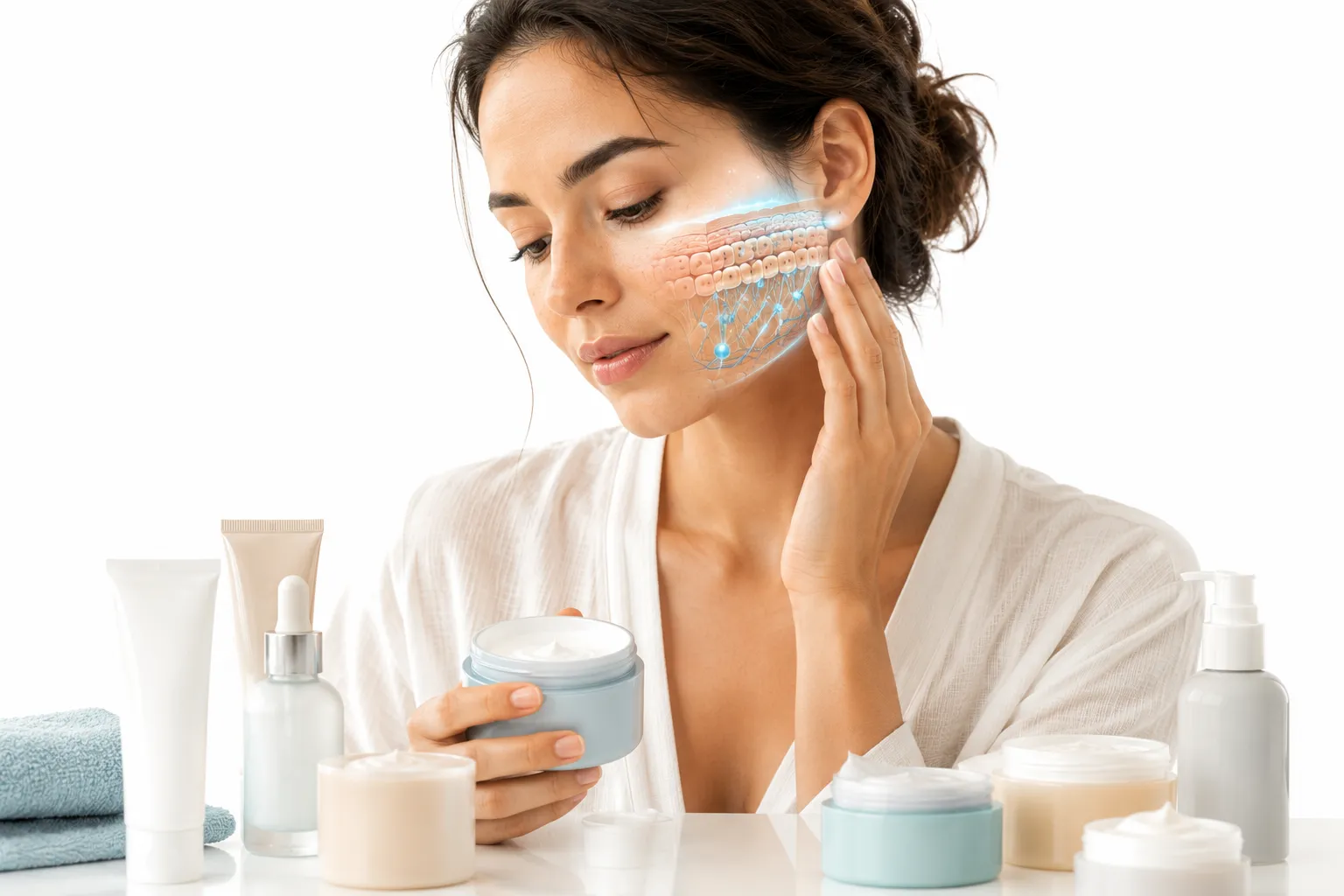
Barrier repair isn't just about adding moisture - it's about providing the exact building blocks your skin needs to rebuild its structural integrity. The right ratios matter as much as the right ingredients.
Use this section to decide
Does this advice apply to me?
Find the concern or goal closest to yours, then use the fit signal to decide how much weight to give this guide.If your goal is
Key ingredientsUsually relevant- Fit signal
- Often useful
Ceramides, cholesterol, fatty acids, niacinamide
If your goal is
AvoidDepends- Fit signal
- Possible fit
Fragrances, essential oils, drying alcohols
If your goal is
ApplicationUse caution- Fit signal
- Limited evidence
Apply to damp skin, morning and night
If your goal is
Results timelineDepends- Fit signal
- Possible fit
Weeks to months
Practical use
How to use it
Cleanse gently
Use a non-foaming, pH-balanced cleanser.
Apply to damp skin
Apply the barrier-repair moisturizer immediately after cleansing, while skin is still damp.
Seal with an occlusive (optional)
For severe barrier damage, layer a thin amount of petrolatum or other occlusive on top.
Safety
Side effects and cautions
- Using a moisturizer with fragrances or essential oils
These can irritate an already compromised barrier.
- Not using the moisturizer consistently
Barrier repair requires consistent application - morning and night.
- Applying to dry skin
Apply to damp skin for better absorption and hydration.
Fit
Who should be careful
- Oily skin without barrier damage
Worth noting
Small details that can change the answer
- Ideal Ratio. The optimal barrier-repair formula mimics the skin's natural lipid ratio.
- Ceramides Are Key. Ceramides make up about 50% of the barrier's lipid content.
- Niacinamide Boost. Niacinamide can increase the skin's own ceramide production.
- Avoid Irritants. Fragrances and essential oils can worsen barrier damage.
The best barrier-repair moisturizer contains ceramides, cholesterol, and fatty acids in the right ratios.
Niacinamide and panthenol are valuable supporting ingredients.
Avoid fragrances, essential oils, and drying alcohols.
Apply to damp skin for best absorption.
Consistency is key - apply morning and night.
Definition
What to look for in a barrier-repair moisturizer
The best barrier-repair moisturizers are specifically formulated to provide the building blocks your skin needs.
- Contains ceramides (look for ceramide NP, AP, or EOP)
- Contains cholesterol (often listed as "cholesterol" or "cholesteryl")
- Contains fatty acids (look for linoleic acid, oleic acid)
- Contains niacinamide (vitamin B3) to boost ceramide production
- Contains panthenol (vitamin B5) for soothing and hydration
- Fragrance-free and alcohol-free
- Formulated for sensitive skin
Ingredient Comparison
Key ingredients for barrier repair
Ceramides
bestBest for: Rebuilding the lipid matrixPrimary barrier lipid · Essential for barrier repair
Cholesterol
bestBest for: Lipid matrix supportSecondary barrier lipid · Works with ceramides
Fatty acids
bestBest for: Lipid matrix supportEssential component · Supports barrier function
Niacinamide
bestBest for: Boosting ceramide productionStimulates natural ceramide synthesis · Anti-inflammatory
Panthenol
goodBest for: Soothing and hydrationSoothes irritation · Humectant properties
Squalane
goodBest for: Emollient and barrier supportSmooths skin · Supports barrier
Science
The science of barrier-repair formulations
Research has shown that the most effective barrier-repair formulations mimic the skin's natural lipid composition. The stratum corneum is composed of approximately 50% ceramides, 25% cholesterol, and 15% fatty acids by weight. Products that replicate these ratios are more effective at restoring barrier function than those that focus on a single lipid. Additionally, niacinamide at 2-5% concentration has been shown to significantly increase ceramide production.
- Lipid Ratio
- The proportion of different lipids in the barrier, which should be mimicked in repair products.
- Ceramide Synthesis
- The production of ceramides by the skin, which niacinamide can stimulate.
Product Comparison
Types of barrier-repair moisturizers
Barrier repair creams
Experienced useBest for: Severe barrier damageRich in lipids · High concentration of ceramides · Intensive repair
Ceramide-rich lotions
Beginner friendlyBest for: Mild to moderate barrier damageLightweight but effective · Good for daily use
Ointments
Experienced useBest for: Severe damage or very dry skinMaximum occlusive effect · Locks in moisture
Consider: Heavy · May feel greasyGel-creams with ceramides
Beginner friendlyBest for: Combination skin with barrier damageLightweight · Absorbs quickly
Questions
Frequently asked questions
What ingredients should I look for in a barrier-repair moisturizer?
Ceramides, cholesterol, fatty acids, niacinamide, and panthenol.
Can I use a regular moisturizer for barrier repair?
It may help, but a specifically formulated barrier-repair moisturizer is more effective.
How long does it take for a barrier-repair moisturizer to work?
You may see improvement in weeks, but full barrier repair can take months.
Should I use a barrier-repair moisturizer with other products?
Keep your routine simple - cleanser, barrier-repair moisturizer, and sunscreen. Avoid actives.